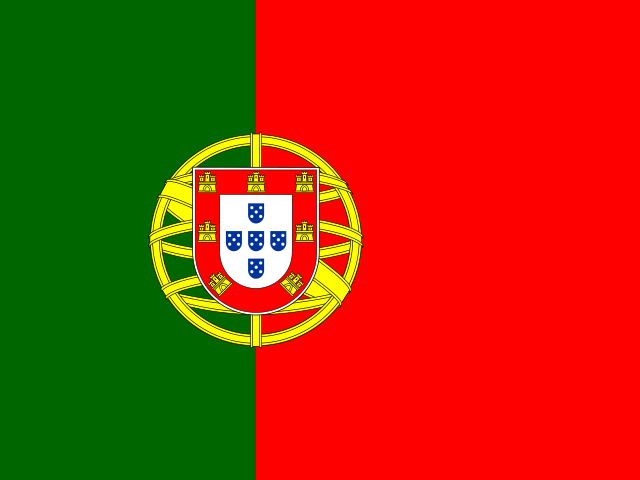
What the flag looks like
The Portuguese flag is a vertical bicolor of green on the hoist side (two-fifths of the length) and red on the fly side (three-fifths). Centered on the boundary between the two colors is the Portuguese coat of arms: an armillary sphere in yellow and red behind a white-bordered red shield containing five small blue shields (the quinas) and seven yellow castles. The proportion is 2:3.
Colors and meaning
Green represents hope and the Portuguese landscape, and red represents the blood shed for Portuguese independence and the courage of the nation. The armillary sphere is a navigational instrument symbolizing Portugal's Age of Discovery, and the shield represents the country's medieval foundations.
Green
Represents hope for the future and the natural landscape of Portugal. Green was not on the flag before 1910 and was added by the republican government.
Red
Represents courage, the blood shed for Portuguese independence and the Portuguese people. Red has been a national color since the 15th century.
Armillary sphere
A navigational instrument used by Portuguese explorers, symbolizing the Age of Discovery in the 15th and 16th centuries.
Quinas
The five small blue shields inside the main red shield represent the five wounds of Christ and the five Moorish kings defeated by Afonso I at the Battle of Ourique in 1139.
Seven castles
Represent the seven fortified cities captured from the Moors by Afonso III in 1249.
History and adoption
The Portuguese flag was adopted on 30 June 1911, following the establishment of the Portuguese Republic in 1910. A special commission chose the green-red design over the traditional blue-white monarchic flag. The colors were associated with the republican movement and Portugal's maritime tradition. The armillary sphere and Portuguese shield were retained from earlier flags, and the current version has remained unchanged since its adoption.
Key facts
- Adopted
- 30 June 1911
- Proportion
- 2:3
- Designer
- Columbano Bordalo Pinheiro, João Chagas and Abel Botelho
- Capital
- Lisbon
- Country code
- PT
- Similar flags
- Italy, Mexico
Historical and related flags
Portugal has used several national flags across its long history, most of them blue and white.
- Kingdom of Portugal (1143–1248): White flag with a blue cross.
- Kingdom of Portugal (1248–1385): White flag with the Portuguese shield.
- Joanine flag (1485–1495): White with a black armillary sphere.
- Manueline flag (1495–1521): White with the armillary sphere and shield.
- Liberal flag (1830–1910): Blue and white bicolor with the armillary sphere and shield.
- Republican flag (1911–present): Green and red bicolor with the armillary sphere and shield.
Frequently asked questions
What does the flag of Portugal look like?
The flag of Portugal is divided vertically into green on the hoist and red on the fly, with the Portuguese coat of arms — an armillary sphere behind a shield with seven castles and five quinas — on the boundary between the two colors.
When was the flag of Portugal adopted?
The current flag of Portugal was officially adopted on 30 June 1911.
What do the colors mean?
Green represents hope and the Portuguese landscape, and red represents the blood shed for Portuguese independence and the courage of the nation. The armillary sphere is a navigational instrument symbolizing Portugal's Age of Discovery, and the shield represents the country's medieval foundations.
Which flags look similar to the Portugal flag?
Italy uses vertical green-white-red bands, and Mexico uses vertical green-white-red with an eagle emblem. Portugal's green and red are on a vertical bicolor with a complex armillary sphere emblem, making the flag visually distinct.

 Spain
 Brazil
 Italy
 Mexico
 Morocco
 Timor-Leste