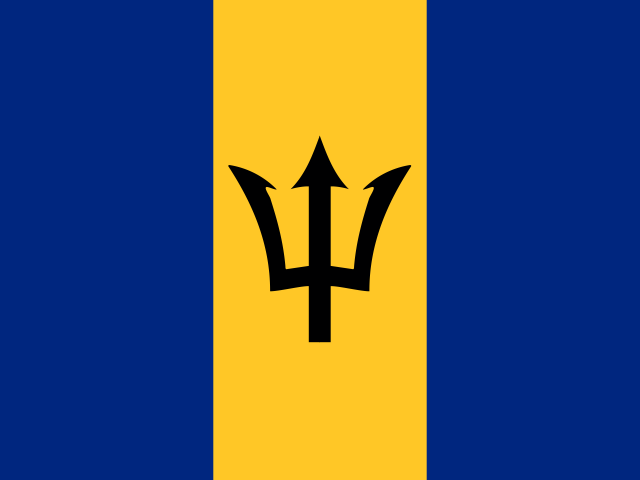
What the flag looks like
The Barbadian flag consists of a vertical band of ultramarine blue on the hoist, a wider central band of gold, and another vertical band of ultramarine blue on the fly. In the center of the gold band is a black trident head with the shaft broken off. The proportion is 2:3. It was adopted on 30 November 1966, when Barbados gained independence from Britain.
Colors and meaning
The ultramarine bands represent the Caribbean Sea and the Atlantic Ocean that surround Barbados, the gold band represents the golden sand of the island's beaches, and the black broken trident is a symbol of Barbados' independence — the broken shaft represents the break from Britain's colonial rule, and the trident itself is taken from the British colonial badge of Barbados.
Ultramarine bands
Represent the Caribbean Sea, which lies to the west of Barbados, and the Atlantic Ocean, which lies to the east. Barbados is the easternmost island in the Caribbean, and the ocean has shaped its history, culture and economy.
Gold band
Represents the golden sand of the island's famous beaches, which are central to Barbadian tourism and national identity. Gold also represents the warmth of the Barbadian sun and the country's bright future.
Broken trident
The black trident head with its shaft broken off is the central symbol of the flag. It represents the breaking of the colonial tie with Britain — Barbados became independent on 30 November 1966, and the broken shaft symbolizes that break. The trident itself is taken from the colonial badge of Barbados, which showed Britannia holding a trident. In the Barbadian flag, the trident is broken and held aloft by the people, symbolizing the transfer of power from Britain to the Barbadian people.
Design origin
The flag was designed by Grantley W. Prescod, a Barbadian artist, in a national competition held in 1966. His design was chosen from 1,029 entries and was adopted on independence day. The broken trident was Prescod's most distinctive contribution to the design, and it has become one of the most recognizable national symbols in the Caribbean.
History and adoption
Barbados was a British colony from 1627 until 1966, when it gained independence on 30 November 1966 as a Commonwealth realm with Queen Elizabeth II as head of state. The flag was designed by Grantley W. Prescod in a national competition held in preparation for independence. It was adopted on independence day and has remained unchanged since, including when Barbados transitioned from a Commonwealth realm to a republic on 30 November 2021, replacing the British monarch with a ceremonial president as head of state. The flag itself was not changed when the country became a republic.
Key facts
- Adopted
- 30 November 1966
- Proportion
- 2:3
- Designer
- Grantley W. Prescod
- Capital
- Bridgetown
- Country code
- BB
- Similar flags
- None
Historical and related flags
Barbados used several flags during its British colonial period before independence.
- British Barbados (1627–1885): British Blue Ensign with a colonial badge.
- British Barbados (1885–1958): Blue Ensign with a colonial badge featuring Britannia holding a trident.
- West Indies Federation (1958–1962): Blue field with four white wavy stripes and a yellow sun.
- British Barbados (1962–1966): Blue Ensign with the Britannia badge.
- Current flag (1966–present): Ultramarine and gold bands with a broken trident.
- Presidential standard (2021–present): Uses the Barbadian coat of arms on a blue field.
Frequently asked questions
What does the flag of Barbados look like?
The flag of Barbados has two vertical bands of ultramarine (hoist) and gold (fly), with a black broken trident head in the center of the gold band. The proportion is 2:3.
When was the flag of Barbados adopted?
The current flag of Barbados was officially adopted on 30 November 1966.
What do the colors mean?
The ultramarine bands represent the Caribbean Sea and the Atlantic Ocean that surround Barbados, the gold band represents the golden sand of the island's beaches, and the black broken trident is a symbol of Barbados' independence — the broken shaft represents the break from Britain's colonial rule, and the trident itself is taken from the British colonial badge of Barbados.
Which flags look similar to the Barbados flag?
No other national flag closely resembles Barbados'. The combination of ultramarine and gold vertical bands with a black broken trident is unique.

 Jamaica
 Trinidad and Tobago
 Bahamas
 Guyana
 Grenada
 Saint Lucia