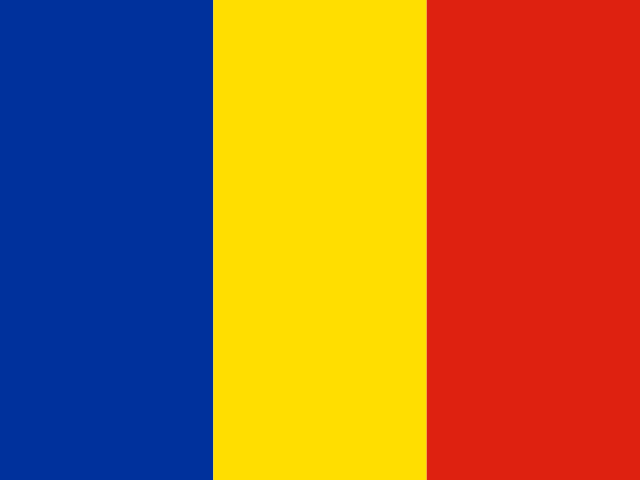
What the flag looks like
The Romanian flag consists of three equal vertical bands of blue (hoist), yellow (center) and red (fly). The proportion is 2:3. It was readopted on 27 December 1989, immediately after the fall of Nicolae Ceaușescu, removing the communist coat of arms that had been in the center since 1948. The plain tricolor itself dates back to 1848.
Colors and meaning
Blue represents liberty and the sky, yellow represents justice and the country's fertile fields, and red represents brotherhood and the blood shed for Romanian independence. The colors appeared together in Romanian heraldry as early as the 16th century and were formally adopted as the national tricolor during the Wallachian Revolution of 1848.
Blue
Represents liberty, the sky and the Danube River, and is one of the oldest colors in Romanian heraldry, appearing on the arms of several medieval Romanian principalities.
Yellow
Represents justice, prosperity and the fertile plains of Wallachia and Moldavia.
Red
Represents brotherhood, courage and the blood shed for Romanian independence, particularly during the 1848 revolutions and the War of Independence of 1877–1878.
Origin
The three colors appeared together on the flag of the Wallachian Revolution of 1848, inspired by the French Tricolore and by earlier Romanian heraldic traditions.
History and adoption
The Romanian tricolor was first used during the Wallachian Revolution of 1848, when blue-yellow-red horizontal bands were adopted by revolutionaries in Bucharest. In 1861, the design was changed to vertical bands to resemble the French Tricolore. Romania adopted the tricolor as the national flag upon independence in 1877. From 1948 to 1989, the communist government added a coat of arms in the center featuring wheat, forests, oil derricks and a red star. On 27 December 1989, during the Romanian Revolution, the plain tricolor was restored and has remained unchanged since.
Key facts
- Adopted
- 27 December 1989
- Proportion
- 2:3
- Designer
- Traditional — derived from Wallachian heraldry
- Capital
- Bucharest
- Country code
- RO
- Similar flags
- Chad, Moldova, Andorra
Historical and related flags
Romania has used several national flags across its monarchic, communist and post-communist periods.
- Wallachian Revolution (1848): Blue-yellow-red horizontal tricolor.
- United Principalities (1861–1866): Vertical tricolor adopted.
- Kingdom of Romania (1881–1947): Tricolor with the royal coat of arms in the center.
- Romanian People's Republic (1948–1965): Tricolor with a communist coat of arms.
- Socialist Republic of Romania (1965–1989): Same design with a modified coat of arms.
- Current flag (1989–present): Plain blue-yellow-red tricolor.
Frequently asked questions
What does the flag of Romania look like?
The flag of Romania has three equal vertical bands of blue (hoist), yellow (center) and red (fly). The proportion is 2:3.
When was the flag of Romania adopted?
The current flag of Romania was officially adopted on 27 December 1989.
What do the colors mean?
Blue represents liberty and the sky, yellow represents justice and the country's fertile fields, and red represents brotherhood and the blood shed for Romanian independence. The colors appeared together in Romanian heraldry as early as the 16th century and were formally adopted as the national tricolor during the Wallachian Revolution of 1848.
Which flags look similar to the Romania flag?
Chad uses an almost identical blue-yellow-red vertical tricolor, with a slightly darker blue. Moldova uses the same tricolor with the Moldovan coat of arms in the center. The similarity between Romania's and Chad's flags is one of the most commonly confused pairs in vexillology.

 Chad
 Moldova
 Andorra
 France
 Italy
 Bulgaria