What the flag looks like
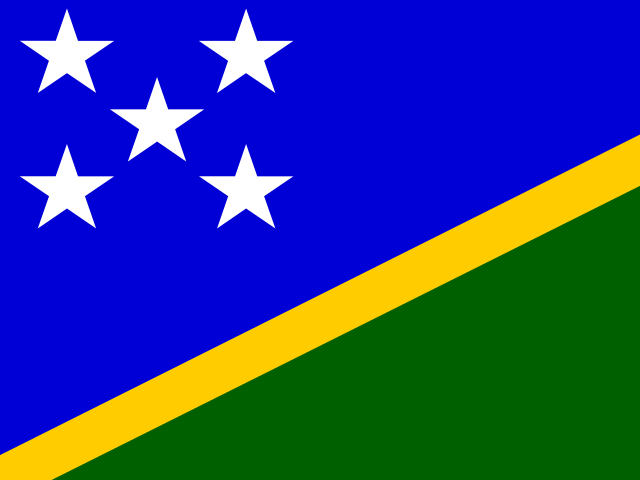
The flag of Solomon Islands is divided diagonally by a yellow stripe running from the lower hoist corner to the upper fly corner. The upper triangle is blue and contains five white five-pointed stars arranged in an X (quincunx) pattern. The lower triangle is green. The proportion is 1:2. It was adopted on 18 November 1977, when the country became self-governing, and was retained when Solomon Islands gained full independence from Britain on 7 July 1978.
Colors and meaning
Blue represents the Pacific Ocean that surrounds the archipelago, green represents the lush vegetation and agricultural wealth of the islands, yellow represents the sunshine that bathes the islands, and the five white stars represent the five main island groups of Solomon Islands — Choiseul, New Georgia, Santa Isabel, Malaita and Guadalcanal.
Blue triangle
Represents the Pacific Ocean that surrounds the Solomon Islands archipelago, which stretches across about 1,500 kilometers of the South Pacific. Blue also represents the country's maritime heritage and fishing industry.
Green triangle
Represents the lush tropical vegetation and agricultural wealth of the islands. The Solomon Islands are covered in dense rainforest and are known for their copra, cocoa, palm oil and timber exports.
Yellow stripe
Represents the sunshine that bathes the islands year-round, giving them a tropical climate and supporting their agricultural economy.
Five white stars
Represent the five main island groups of Solomon Islands — Choiseul, New Georgia, Santa Isabel, Malaita and Guadalcanal. The stars are arranged in an X (quincunx) pattern, a traditional arrangement symbolizing unity and balance.
Design origin
The flag was designed in a national competition held in 1977 in preparation for independence. The winning design combined the blue of the ocean, the green of the land and the yellow of the sun, with five stars representing the country's main island groups. It was adopted on 18 November 1977 and retained at independence on 7 July 1978.
History and adoption
Solomon Islands was a British protectorate from 1893 until 1978, when it gained independence on 7 July 1978. The flag was designed in a national competition held in 1977 and was adopted on 18 November 1977, when the country became self-governing. The design combined the colors of the landscape — blue for the ocean, green for the vegetation and yellow for the sun — with five white stars representing the country's main island groups. During the colonial period, the territory used the British Blue Ensign with a colonial badge. The current flag has remained unchanged since independence, including through the ethnic tensions of 1998–2003 (the 'Tensions') and the subsequent peace process.
Key facts
- Adopted
- 18 November 1977
- Proportion
- 1:2
- Designer
- Based on a design by a national competition winner
- Capital
- Honiara
- Country code
- SB
- Similar flags
- Tanzania, Papua New Guinea
Historical and related flags
Solomon Islands used several flags during its British colonial period before independence.
- British Solomon Islands (1893–1906): British Union Jack used as the official flag.
- British Solomon Islands (1906–1947): British Blue Ensign with a colonial badge featuring a turtle and other symbols.
- British Solomon Islands (1947–1977): Blue Ensign with an updated colonial badge.
- Current flag (1977–present): Blue and green diagonals with a yellow stripe and five white stars.
- Governor-General's standard: Uses the Solomon Islands coat of arms on a blue field.
Frequently asked questions
What does the flag of Solomon Islands look like?
The flag of Solomon Islands is divided diagonally by a yellow stripe from the lower hoist to the upper fly. The upper triangle is blue and the lower is green, with five white five-pointed stars arranged in an X pattern in the blue triangle. The proportion is 1:2.
When was the flag of Solomon Islands adopted?
The current flag of Solomon Islands was officially adopted on 18 November 1977.
What do the colors mean?
Blue represents the Pacific Ocean that surrounds the archipelago, green represents the lush vegetation and agricultural wealth of the islands, yellow represents the sunshine that bathes the islands, and the five white stars represent the five main island groups of Solomon Islands — Choiseul, New Georgia, Santa Isabel, Malaita and Guadalcanal.
Which flags look similar to the Solomon Islands flag?
Tanzania uses a similar diagonal design with green, black, yellow and blue. Papua New Guinea uses red and black diagonals with a bird-of-paradise and the Southern Cross. Solomon Islands' blue and green diagonals with a yellow stripe and five white stars is distinct.

 Papua New Guinea
 Vanuatu
 Fiji
 Australia
 Tanzania
 Tuvalu