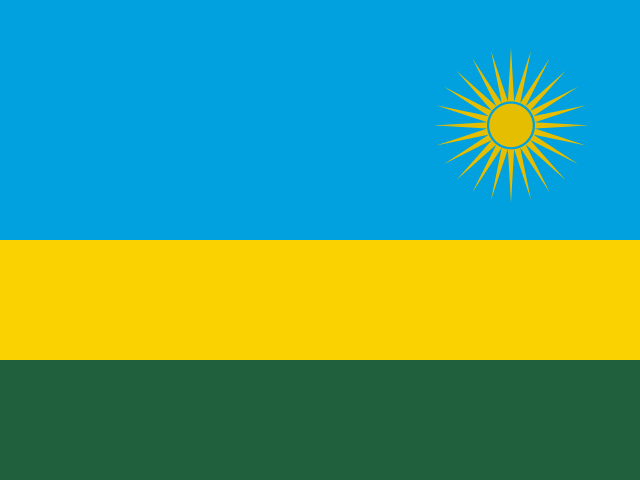
What the flag looks like
The Rwandan flag consists of four horizontal bands: blue (top, half the width), yellow (quarter) and two green bands (each eighth of the width). In the upper right corner of the blue band is a golden sun with 24 rays. The proportion is 2:3. It was adopted on 25 October 2001, replacing the flag used since 1961, which had been associated with the 1994 Rwandan genocide.
Colors and meaning
Blue represents peace and happiness and the Rwandan people's hope for a bright future, yellow represents economic development and mineral wealth, and green represents prosperity and the country's natural resources. The golden sun represents enlightenment, unity and the fight against ignorance.
Blue
Represents peace, happiness and the Rwandan people's hope for a peaceful and prosperous future, especially after the 1994 genocide against the Tutsi.
Yellow
Represents economic development and mineral wealth. Rwanda has significant mineral resources, including tin, tungsten and gold.
Green
Represents prosperity and the country's natural resources and agriculture. Rwanda is known as the 'Land of a Thousand Hills' for its mountainous terrain and rich vegetation.
Golden sun
Represents enlightenment, unity and the fight against ignorance. The 24 rays of the sun represent the unity of the Rwandan people and their collective effort to build a new nation after the genocide.
Symbolic break from the past
The flag was designed to be completely different from the previous flag, which had been associated with the genocide and the political divisions that led to it. The new design emphasizes unity, peace and a shared national identity.
History and adoption
Rwanda gained independence from Belgium on 1 July 1962 and adopted a flag with vertical bands of red, yellow and green and a black 'K' in the center, representing the Hutu-led government. This flag remained in use until 2001, including through the 1994 genocide against the Tutsi, in which around 800,000 people were killed in about 100 days. After the genocide, the new Rwandan government under the Rwandan Patriotic Front (RPF) decided to create a new flag to symbolize a break with the past. The current design was adopted on 25 October 2001 and has remained unchanged since.
Key facts
- Adopted
- 25 October 2001
- Proportion
- 2:3
- Designer
- Alphonse Kirimobenecyo
- Capital
- Kigali
- Country code
- RW
- Similar flags
- None
Historical and related flags
Rwanda has used two flags since independence, with the current design adopted to break from the past.
- German East Africa (1894–1916): German colonial flags.
- Belgian Ruanda-Urundi (1916–1962): Belgian colonial flags.
- First Rwandan flag (1962–2001): Red, yellow and green vertical bands with a black K in the center.
- Current flag (2001–present): Blue, yellow and green bands with a golden sun.
- Presidential standard: Uses the Rwandan coat of arms on a blue field.
Frequently asked questions
What does the flag of Rwanda look like?
The flag of Rwanda has four horizontal bands: blue (top, half the width), yellow (quarter) and two equal green bands (quarter). A golden sun with 24 rays sits in the upper hoist corner of the blue band. The proportion is 2:3.
When was the flag of Rwanda adopted?
The current flag of Rwanda was officially adopted on 25 October 2001.
What do the colors mean?
Blue represents peace and happiness and the Rwandan people's hope for a bright future, yellow represents economic development and mineral wealth, and green represents prosperity and the country's natural resources. The golden sun represents enlightenment, unity and the fight against ignorance.
Which flags look similar to the Rwanda flag?
No other national flag closely resembles Rwanda's. The combination of blue, yellow and green bands with a golden sun in the upper hoist corner is unique.

 Uganda
 Tanzania
 Burundi
 DR Congo
 Kenya
 South Sudan