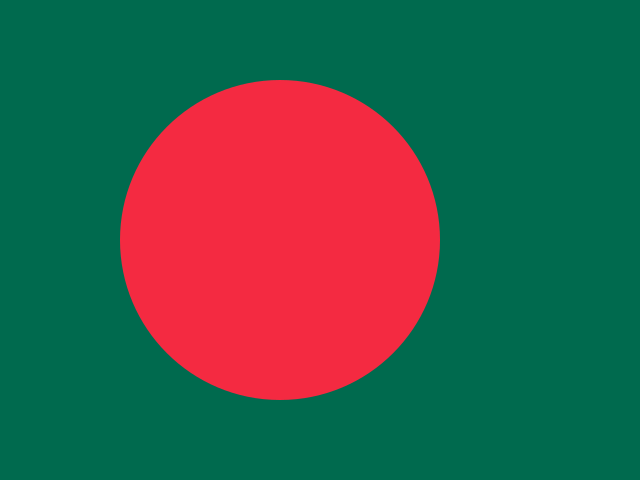
What the flag looks like
The Bangladeshi flag consists of a dark green field with a red disc centered slightly toward the hoist. The proportion is 3:5. It was adopted on 17 January 1972, following Bangladesh's independence from Pakistan in 1971, and is based on the flag used by the Mukti Bahini during the Bangladesh Liberation War.
Colors and meaning
Green represents the lush vegetation and fertility of Bangladesh's land, and red represents the blood shed by Bangladeshis during the Bangladesh Liberation War of 1971, and the rising sun of independence.
Green
Represents the lush vegetation and agricultural wealth of Bangladesh, one of the most fertile countries in the world. Green is also the traditional color of Islam, the dominant religion of Bangladesh.
Red disc
Represents the blood shed by Bangladeshis during the Bangladesh Liberation War of 1971, in which an estimated 300,000 to 3 million people died. The disc also represents the rising sun of independence — a new dawn for the Bengali nation.
Design origin
The flag is based on the flag used by the Mukti Bahini (Liberation Army) during the 1971 war. That flag was similar but included a golden map of Bangladesh in the center of the red disc. The map was removed when the flag was formally adopted on 17 January 1972 to simplify the design and avoid reproducing the country's borders on a national symbol.
Disc position
The red disc is positioned slightly toward the hoist, so that it appears centered when the flag is flying from a mast — a deliberate design choice that gives the flag a balanced appearance in motion.
History and adoption
Bangladesh was part of British India until 1947, when it became East Pakistan as part of the newly created state of Pakistan. In 1971, after years of political and economic discrimination, East Pakistan declared independence as Bangladesh, sparking the Bangladesh Liberation War. India intervened on Bangladesh's side, and Pakistan surrendered on 16 December 1971. The flag was adopted on 17 January 1972, based on the flag used by the Mukti Bahini during the liberation war. The original design included a golden map of Bangladesh in the center of the red disc, which was removed to simplify the flag. The flag has remained unchanged since.
Key facts
- Adopted
- 17 January 1972
- Proportion
- 3:5
- Designer
- Quamrul Hassan
- Capital
- Dhaka
- Country code
- BD
- Similar flags
- Japan, Palau
Historical and related flags
Bangladesh used several flags during its time as part of British India and Pakistan, and has had one variation since independence.
- British India (1858–1947): British Indian flags used during colonial rule.
- East Pakistan (1947–1971): Pakistani flag used during this period.
- Provisional flag (1971): Green field with a red disc and a golden map of Bangladesh.
- Current flag (1972–present): Green field with a red disc, map removed.
- Presidential standard: Uses the Bangladeshi coat of arms with a water lily and rice sheaves.
Frequently asked questions
What does the flag of Bangladesh look like?
The flag of Bangladesh is a green field with a red disc positioned slightly toward the hoist. The proportion is 3:5.
When was the flag of Bangladesh adopted?
The current flag of Bangladesh was officially adopted on 17 January 1972.
What do the colors mean?
Green represents the lush vegetation and fertility of Bangladesh's land, and red represents the blood shed by Bangladeshis during the Bangladesh Liberation War of 1971, and the rising sun of independence.
Which flags look similar to the Bangladesh flag?
Japan uses a red disc on a white field. Palau uses a yellow disc on a light blue field. Bangladesh's red disc on a green field is unique, though the design is sometimes compared to Japan's flag.

 India
 Pakistan
 Sri Lanka
 Nepal
 Myanmar
 Japan