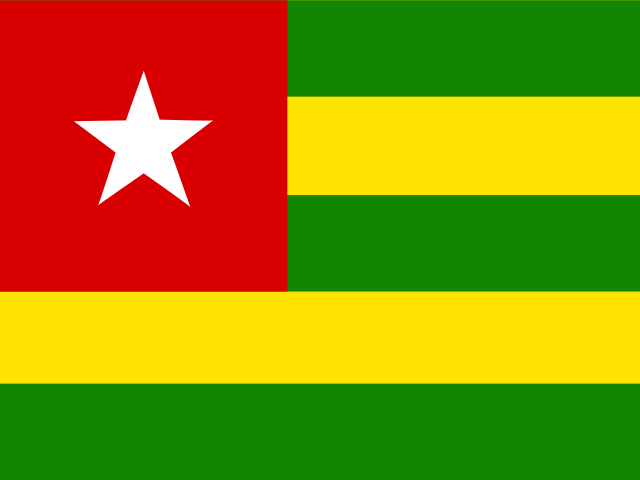
What the flag looks like
The Togolese flag consists of five horizontal stripes of green and yellow, alternating with green at the top and bottom. A red square canton in the upper hoist corner bears a white five-pointed star. The proportion is 1:1.618 — unique among national flags for using the golden ratio. It was adopted on 27 April 1960, when Togo gained independence from France.
Colors and meaning
Green represents the country's forests, agriculture and hope for the future, yellow represents the country's mineral wealth and the savanna of the north, red represents the blood shed for independence and the courage of the Togolese people, and the white star represents hope, purity and the guiding light of the Togolese nation.
Green
Represents Togo's forests, agricultural land and hope for the future. The country's economy is heavily dependent on agriculture, particularly cocoa, coffee and cotton.
Yellow
Represents Togo's mineral wealth — the country has significant phosphate reserves — and the savanna of the north.
Red canton
Represents the blood shed by Togolese patriots in the struggle for independence from France, achieved in 1960, and the courage and sacrifice of the Togolese people.
White star
Represents hope, purity and the guiding light of the Togolese nation. The star's five points symbolize the unity of Togo's diverse ethnic groups.
Golden ratio
The flag's proportions (1:1.618) are based on the golden ratio — the only national flag in the world that uses this proportion. This was intended to give the flag a balanced, harmonious appearance.
History and adoption
Togo was a German colony from 1884 until 1914, then was split between British and French administration after World War I. British Togoland voted to join Ghana in 1956, while French Togoland became the Republic of Togo on 27 April 1960. The flag was designed by Paul Ahyi, a Togolese artist, and was adopted on independence day. It has remained unchanged since, despite decades of political instability including the long rule of Gnassingbé Eyadéma and the contested transfer of power to his son Faure Gnassingbé in 2005.
Key facts
- Adopted
- 27 April 1960
- Proportion
- 1:1.618
- Designer
- Paul Ahyi
- Capital
- Lomé
- Country code
- TG
- Similar flags
- Liberia, Malaysia
Historical and related flags
Togo used several flags during its German and French colonial periods before independence.
- German Togoland (1884–1914): German colonial flags.
- British and French Togoland (1914–1956): British and French flags used jointly.
- French Togoland (1956–1960): French flag used during transition period.
- Current flag (1960–present): Five stripes with a white star in a red canton.
- Presidential standard: Uses the Togolese coat of arms with two lions and a golden star.
Frequently asked questions
What does the flag of Togo look like?
The flag of Togo has five horizontal stripes of green and yellow, alternating with green at the top and bottom, and a red square canton in the upper hoist corner bearing a white five-pointed star. The proportion is 1:1.618, based on the golden ratio.
When was the flag of Togo adopted?
The current flag of Togo was officially adopted on 27 April 1960.
What do the colors mean?
Green represents the country's forests, agriculture and hope for the future, yellow represents the country's mineral wealth and the savanna of the north, red represents the blood shed for independence and the courage of the Togolese people, and the white star represents hope, purity and the guiding light of the Togolese nation.
Which flags look similar to the Togo flag?
Liberia uses 11 stripes with a white star in a blue canton. Malaysia uses 14 stripes with a crescent and stars. Togo's five stripes with a white star in a red canton is unique.

 Ghana
 Benin
 Burkina Faso
 Ivory Coast
 Liberia
 Nigeria