What the flag looks like
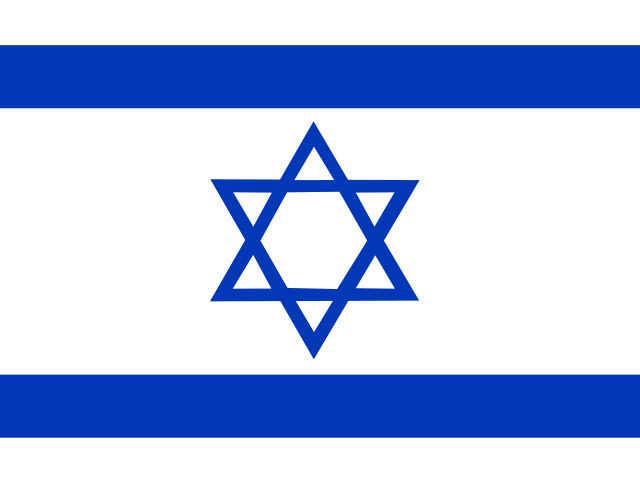
The Israeli flag consists of a white field with two horizontal blue stripes — one near the top edge and one near the bottom edge — and a blue six-pointed Star of David centered between them. The proportion is 8:11. It was adopted on 28 October 1948, five months after the establishment of the State of Israel, and has remained unchanged since.
Colors and meaning
White represents purity, honesty and peace, and blue represents the sky, faith and the traditional blue of Jewish prayer shawls. The Star of David is a symbol of Judaism and Jewish identity, and the two stripes evoke the tallit (Jewish prayer shawl), which has blue or black stripes near its ends.
White
Represents purity, honesty and peace. White is also the background color of the traditional Jewish prayer shawl, the tallit, which inspired the design.
Blue stripes
The two blue stripes represent the stripes on the tallit, the Jewish prayer shawl worn during prayer. The blue color is associated with tekhelet, a blue dye mentioned in the Torah and used in ancient Jewish ritual garments. Blue also represents the sky and the heavens, and the connection between the Jewish people and the land of Israel.
Star of David
The blue six-pointed star in the center is the Magen David ('Shield of David'), which has been a symbol of Judaism and Jewish identity since the Middle Ages. It became the central emblem of the Zionist movement in the late 19th century and was used on the flag of the World Zionist Organization, designed by David Wolffsohn in 1891. The star appears on the flag as two overlapping triangles, with no fill.
Design origin
The design was based on the flag of the World Zionist Organization, which was itself inspired by the tallit. The State of Israel adopted it as the national flag on 28 October 1948, five months after declaring independence on 14 May 1948.
History and adoption
The Zionist flag — a white field with blue stripes and a blue Star of David — was first designed by David Wolffsohn for the World Zionist Organization in 1891, inspired by the traditional Jewish prayer shawl. It was used by Zionist organizations and Jewish communities around the world for decades before the establishment of the State of Israel. On 14 May 1948, Israel declared independence, and on 28 October 1948, the flag was formally adopted by the Provisional Council of State. The design was chosen over several alternatives, including a proposal to include a menorah or the Tablets of the Law. The flag has remained unchanged since, including the exact shade of blue, which has been the subject of some debate (the current shade is a dark blue, sometimes called 'Israeli blue').
Key facts
- Adopted
- 28 October 1948
- Proportion
- 8:11
- Designer
- David Wolffsohn (original Zionist design, 1891)
- Capital
- Jerusalem (proclaimed), Tel Aviv (seat of most embassies)
- Country code
- IL
- Similar flags
- None
Historical and related flags
Israel has used several flags across its Zionist movement and modern statehood periods.
- World Zionist Organization (1891–1948): White field with blue stripes and a blue Star of David.
- Jewish Brigade (1944–1946): Zionist flag used by Jewish volunteers in the British Army.
- State of Israel (1948–present): Current design adopted by the Provisional Council of State.
- Presidential standard: Uses the Israeli coat of arms with a menorah and olive branches.
- Naval ensign: Uses a design similar to the national flag with a darker shade of blue and a different layout.
Frequently asked questions
What does the flag of Israel look like?
The flag of Israel is a white field with two blue horizontal stripes — one near the top and one near the bottom — and a blue six-pointed Star of David (Magen David) in the center. The proportion is 8:11.
When was the flag of Israel adopted?
The current flag of Israel was officially adopted on 28 October 1948.
What do the colors mean?
White represents purity, honesty and peace, and blue represents the sky, faith and the traditional blue of Jewish prayer shawls. The Star of David is a symbol of Judaism and Jewish identity, and the two stripes evoke the tallit (Jewish prayer shawl), which has blue or black stripes near its ends.
Which flags look similar to the Israel flag?
No other national flag closely resembles Israel's. The combination of a white field with two blue stripes and a central Star of David is unique, though it is sometimes compared to the flag of Greece (blue and white with a cross).

 Lebanon
 Jordan
 Egypt
 Syria
 Cyprus
 Greece