What the flag looks like
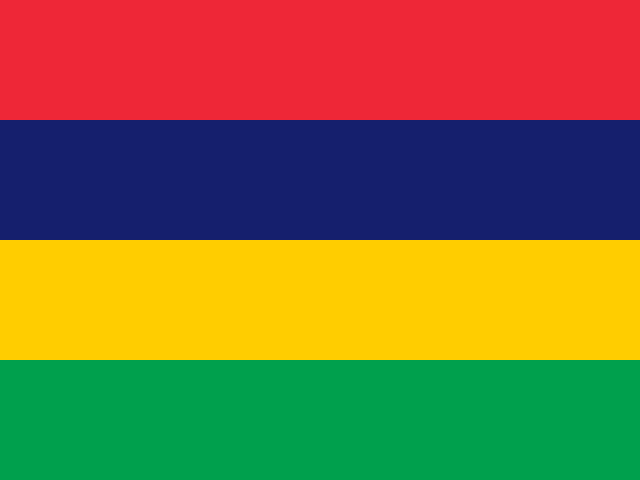
The Mauritian flag, known as the Four Bands (Les Quatre Bandes), consists of four equal horizontal bands of red (top), blue, yellow and green (bottom). The proportion is 2:3. It was adopted on 12 March 1968, when Mauritius gained independence from Britain, and has remained unchanged since, including when the country became a republic in 1992.
Colors and meaning
Red represents the blood shed in the struggle for Mauritian independence, blue represents the Indian Ocean that surrounds the island, yellow represents the light of freedom shining over the island and its golden beaches, and green represents the lush vegetation and agriculture of Mauritius.
Red
Represents the blood shed by Mauritian patriots in the struggle for independence from Britain, achieved in 1968, and the universal symbol of freedom and sovereignty.
Blue
Represents the Indian Ocean that surrounds Mauritius, which is an island nation located about 2,000 kilometers off the southeast coast of Africa.
Yellow
Represents the light of freedom shining over the island, the sun and the golden beaches for which Mauritius is famous. Yellow also represents the country's bright future.
Green
Represents the lush tropical vegetation, forests and agriculture of Mauritius. The island was once covered entirely in forest and remains home to unique plant and animal species.
Design origin
The flag was designed by Gurudutt Moher, a Mauritian teacher, and was chosen in a national competition before independence. It was officially adopted on 12 March 1968. The four bands together represent the unity of Mauritius's diverse population — Indian, African, Chinese and European — living together as one nation.
History and adoption
Mauritius was a French colony from 1715 to 1810, then a British colony until 1968. The flag was designed by Gurudutt Moher in 1968, in preparation for independence, and was adopted on 12 March 1968, when Mauritius became an independent state within the Commonwealth. When Mauritius became a republic on 12 March 1992, the flag was retained unchanged. It has remained the same since, making it one of the more stable flags in the region.
Key facts
- Adopted
- 12 March 1968
- Proportion
- 2:3
- Designer
- Gurudutt Moher
- Capital
- Port Louis
- Country code
- MU
- Similar flags
- None
Historical and related flags
Mauritius used several flags during its French and British colonial periods before independence.
- French Mauritius (1715–1810): French flag used during colonial rule.
- British Mauritius (1810–1968): British Blue Ensign with a colonial badge.
- Current flag (1968–present): Four horizontal bands — red, blue, yellow, green.
- Presidential standard: Uses the Mauritian coat of arms with a dodo and a deer.
Frequently asked questions
What does the flag of Mauritius look like?
The flag of Mauritius has four equal horizontal bands of red (top), blue, yellow and green (bottom). The proportion is 2:3.
When was the flag of Mauritius adopted?
The current flag of Mauritius was officially adopted on 12 March 1968.
What do the colors mean?
Red represents the blood shed in the struggle for Mauritian independence, blue represents the Indian Ocean that surrounds the island, yellow represents the light of freedom shining over the island and its golden beaches, and green represents the lush vegetation and agriculture of Mauritius.
Which flags look similar to the Mauritius flag?
No other national flag closely resembles Mauritius's. The combination of four equal horizontal bands in red, blue, yellow and green is unique among national flags.

 Seychelles
 Madagascar
 Comoros
 Maldives
 Sri Lanka
 France