What the flag looks like
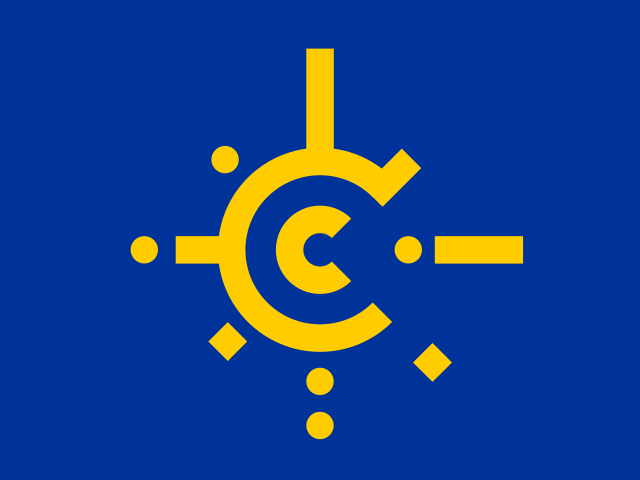
The CEFTA flag consists of a deep blue field with the organization's emblem in gold. The design and color scheme are deliberately similar to the flag of the European Union, reflecting the aspiration of all CEFTA member states to eventually join the EU. The flag has been in use since the 1990s, though the exact date of its adoption is not precisely documented.
Colors and meaning
The deep blue field represents the sky over Europe and the shared values of the Central European nations, and the golden emblem represents the organization's mission of regional cooperation and trade liberalization. The color scheme mirrors the European Union flag, symbolizing the CEFTA members' aspiration to integrate with the EU.
Deep blue field
Represents the sky over Europe and the shared values of the Central European nations that make up CEFTA. The deep blue color is deliberately similar to the blue used on the flag of the European Union, reflecting the CEFTA members' aspiration to eventually join the EU — a goal that all current members share.
Golden emblem
Represents the organization's mission of regional cooperation and trade liberalization. The emblem is composed of a star-based mark that represents European regional cooperation and trade links. The gold color symbolizes prosperity and the economic benefits of free trade among the member states.
European aspiration
The color scheme of the flag — blue field with gold — is intentionally similar to the flag of the European Union. All CEFTA member states aspire to join the EU, and several former members (such as Poland, Czechia, Slovakia, Hungary, Slovenia, Bulgaria, Romania and Croatia) have already done so, leaving CEFTA when they became EU member states. The flag reflects this shared European orientation.
History and adoption
The Central European Free Trade Agreement (CEFTA) was originally signed in 1992 by Poland, Czechoslovakia and Hungary, and came into force in 1993. The original agreement was replaced by a new agreement signed in 2006 in Bucharest, which entered into force in 2007. The flag of CEFTA has been in use since the 1990s, though the exact date of its adoption is not precisely documented. The design was created to represent the organization's mission of regional trade cooperation and its members' shared aspiration to join the European Union. As members have joined the EU, they have left CEFTA, and the organization now includes the Western Balkan countries and Moldova — all of which aspire to eventual EU membership. The flag has remained essentially unchanged since its adoption in the 1990s.
Key facts
- Adopted
- 1990s
- Proportion
- 2:3
- Designer
- CEFTA Secretariat
- Capital
- Brussels (Permanent Secretariat)
- Country code
- CEFTA
- Similar flags
- European Union
Historical and related flags
CEFTA has used the same flag design since the 1990s, with no significant variations.
- Original CEFTA (1992–2006): Flag used by the original organization with Poland, Czechoslovakia, Hungary and later other Central European states.
- CEFTA 2006 (2007–present): Same flag design used by the reorganized organization covering the Western Balkans and Moldova.
- Member state flags: Each of the seven current CEFTA parties — Albania, Bosnia and Herzegovina, Kosovo, Moldova, Montenegro, North Macedonia and Serbia — has its own national flag.
Frequently asked questions
What does the flag of CEFTA look like?
The flag of CEFTA is a deep blue field with the organization's golden emblem in the center. The proportion is roughly 2:3.
When was the flag of CEFTA adopted?
The current flag of CEFTA was officially adopted on 1990s.
What do the colors mean?
The deep blue field represents the sky over Europe and the shared values of the Central European nations, and the golden emblem represents the organization's mission of regional cooperation and trade liberalization. The color scheme mirrors the European Union flag, symbolizing the CEFTA members' aspiration to integrate with the EU.
Which flags look similar to the CEFTA flag?
The flag of the European Union also uses a blue field with golden stars. The CEFTA flag's emblem is different from the EU's circle of twelve stars, but the overall color scheme is deliberately similar to reflect the shared European orientation of the member states.

 European Union
 Albania
 Bosnia and Herzegovina
 Kosovo
 Moldova
 Montenegro
 North Macedonia
 Serbia