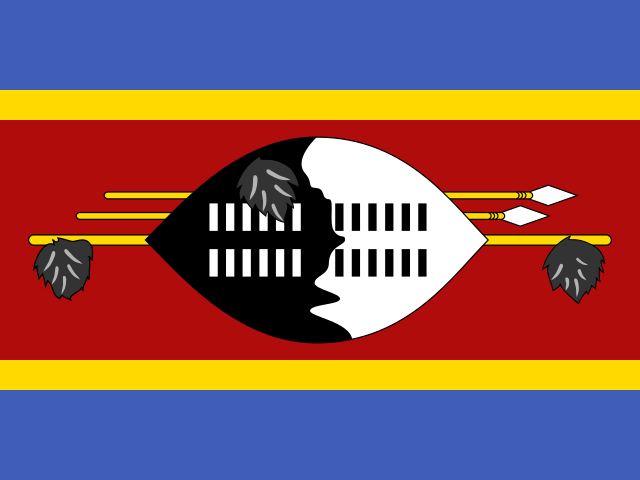
What the flag looks like
The Eswatini flag consists of five horizontal bands: blue (top), yellow, red (center, twice as wide as the others), yellow and blue (bottom). In the center of the red band is an Nguni shield in black and white, overlaid by two spears and a staff decorated with feather tassels. The proportion is 2:3. It was adopted on 6 October 1968, a month after Eswatini (then Swaziland) gained independence from Britain.
Colors and meaning
Red represents the battles and blood shed by the people of Eswatini throughout their history, blue represents peace and stability, and yellow represents the natural resources and mineral wealth of the country. The black and white shield represents the peaceful coexistence of Black and white people and the protection of the nation.
Red
Represents the historical battles and blood shed by the people of Eswatini. The red band is the widest and holds the central shield, emphasizing its importance.
Blue
Represents peace and stability. Blue is also associated with the sky and rain, essential for the country's agriculture.
Yellow
Represents the natural resources and mineral wealth of Eswatini, including its fertile land and mineral deposits.
Nguni shield
The black and white shield is an Nguni shield, a traditional shield used by the Swazi people and other Nguni groups. The black and white colors of the shield represent the peaceful coexistence of Black and white people in Eswatini. The shield itself represents protection and defense of the nation.
Spears and staff
The two spears and the staff decorated with feather tassels represent the defense of the nation and the authority of the king. The colors of the feather tassels — black, white and red — match the shield.
History and adoption
Eswatini, formerly known as Swaziland, was a British protectorate from 1903 until 1968, when it gained independence on 6 September 1968. The flag was adopted on 6 October 1968, a month after independence. The design is based on a flag that had been used by the Swazi people since the 1940s, which was itself based on an older flag used by King Sobhuza II. The 1968 version formalized the design and the colors. In 2018, the country's name was officially changed from Swaziland to Eswatini (meaning 'land of the Swazis'), but the flag remained unchanged.
Key facts
- Adopted
- 6 October 1968
- Proportion
- 2:3
- Designer
- Based on a traditional Swazi design
- Capital
- Mbabane (administrative), Lobamba (legislative)
- Country code
- SZ
- Similar flags
- None
Historical and related flags
Eswatini used several flags during its colonial period and has had minor variations since independence.
- Swaziland Protectorate (1903–1968): British Blue Ensign with a colonial badge.
- Swazi royal standard (1940s–1968): Blue, yellow and red bands with the shield and spears.
- Current flag (1968–present): Blue, yellow and red bands with the Nguni shield.
- Royal standard: Uses the Eswatini coat of arms with a lion and an elephant.
Frequently asked questions
What does the flag of Eswatini look like?
The flag of Eswatini has five horizontal bands — blue, yellow, red (center, twice as wide), yellow and blue — with a black and white Nguni shield in the center, covered by two spears and a staff decorated with feather tassels. The proportion is 2:3.
When was the flag of Eswatini adopted?
The current flag of Eswatini was officially adopted on 6 October 1968.
What do the colors mean?
Red represents the battles and blood shed by the people of Eswatini throughout their history, blue represents peace and stability, and yellow represents the natural resources and mineral wealth of the country. The black and white shield represents the peaceful coexistence of Black and white people and the protection of the nation.
Which flags look similar to the Eswatini flag?
No other national flag closely resembles Eswatini's. The combination of blue, yellow and red bands with the central Nguni shield and spears is unique.

 South Africa
 Lesotho
 Mozambique
 Zimbabwe
 Botswana
 Kenya