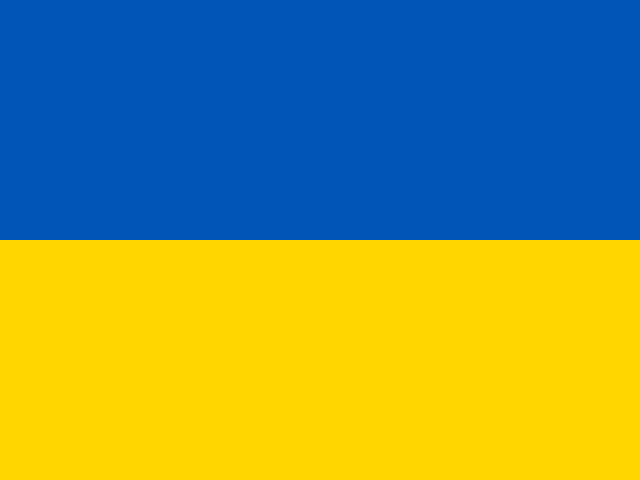
What the flag looks like
The Ukrainian flag consists of two equal horizontal bands of blue (top) and yellow (bottom). The proportion is 2:3. It was officially adopted on 28 January 1992, following Ukraine's declaration of independence from the Soviet Union in 1991, though the design has been used as a national symbol since the 19th century.
Colors and meaning
Blue represents the sky and peace, and yellow represents Ukraine's wheat fields and prosperity. Together they evoke the landscape of the Ukrainian steppe — a blue sky over golden fields of grain — and are among the oldest national colors associated with the Ukrainian people.
Blue
Represents the sky, peace, calm and the enduring spirit of the Ukrainian people. Blue is also associated with the Kyivan Rus' and the coat of arms of the Kingdom of Galicia–Volhynia.
Yellow
Represents Ukraine's wheat fields, golden domes, prosperity and the warmth of the sun. Ukraine has historically been called the 'breadbasket of Europe'.
Origin
The blue-and-yellow combination appeared in the coat of arms of the Kingdom of Galicia–Volhynia in the 13th–14th centuries, and again in the banners of the Cossack Hetmanate in the 17th–18th centuries.
History and adoption
The blue-and-yellow bicolor was first used as a national symbol by Ukrainian nationalists in the 19th century, particularly in Galicia under Austro-Hungarian rule. It was adopted by the Ukrainian People's Republic in 1918 and by the West Ukrainian People's Republic in 1918–1919. Under Soviet rule, the flag was banned and replaced with the red flag of the Ukrainian SSR. On 24 August 1991, Ukraine declared independence and the blue-and-yellow bicolor was raised again. It was formally adopted by the Verkhovna Rada on 28 January 1992.
Key facts
- Adopted
- 28 January 1992
- Proportion
- 2:3
- Designer
- Traditional — derived from Galician and Cossack symbols
- Capital
- Kyiv
- Country code
- UA
- Similar flags
- Sweden, Palau
Historical and related flags
Ukraine has used several flags across its Cossack, revolutionary and Soviet periods.
- Cossack Hetmanate (17th–18th century): Banners using blue and yellow, along with red.
- Ukrainian People's Republic (1917–1921): Blue-and-yellow bicolor adopted as the national flag.
- West Ukrainian People's Republic (1918–1919): Same blue-and-yellow bicolor.
- Ukrainian SSR (1919–1991): Red flag with the Ukrainian SSR emblem; a blue stripe added at the bottom in 1949.
- Ukraine (1992–present): Plain blue-and-yellow bicolor restored.
Frequently asked questions
What does the flag of Ukraine look like?
The flag of Ukraine has two equal horizontal bands of blue (top) and yellow (bottom). The proportion is 2:3.
When was the flag of Ukraine adopted?
The current flag of Ukraine was officially adopted on 28 January 1992.
What do the colors mean?
Blue represents the sky and peace, and yellow represents Ukraine's wheat fields and prosperity. Together they evoke the landscape of the Ukrainian steppe — a blue sky over golden fields of grain — and are among the oldest national colors associated with the Ukrainian people.
Which flags look similar to the Ukraine flag?
Sweden uses a blue field with a yellow Nordic cross. Palau uses a yellow disc on a light blue field. Ukraine's plain blue-and-yellow horizontal bicolor is unique.

 Russia
 Belarus
 Poland
 Romania
 Moldova
 Slovakia