What the flag looks like
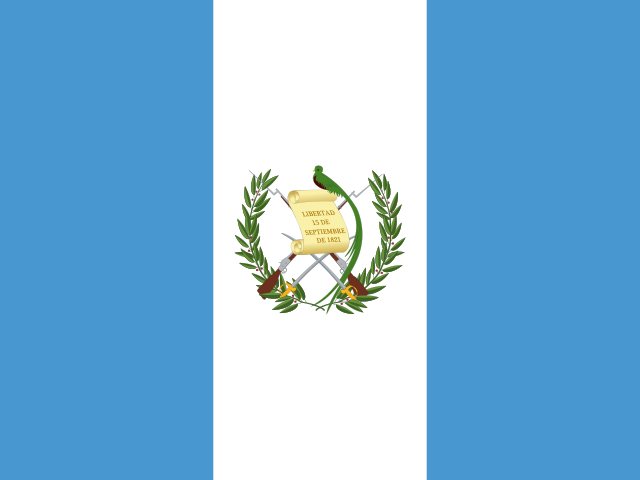
The Guatemalan flag consists of three vertical bands of light blue (hoist), white (center) and light blue (fly). The Guatemalan coat of arms appears in the center of the white band — a resplendent quetzal perched on a scroll bearing the date of independence, crossed rifles and swords, and a laurel wreath. The proportion is 5:8. It was adopted on 17 August 1871 under President Miguel García Granados.
Colors and meaning
Blue represents the Pacific Ocean and the Caribbean Sea that border Guatemala, and the sky, justice and loyalty, and white represents peace, purity and the land between the two oceans. The colors derive from the flag of the United Provinces of Central America, which Guatemala was part of from 1823 to 1841.
Light blue
Represents the two oceans that border Guatemala — the Pacific Ocean to the southwest and the Caribbean Sea to the northeast — and the sky, justice and loyalty. The light blue shade is shared with the other former Central American federation nations.
White
Represents peace, purity and the land between the two oceans. White also represents the desire for peace and unity.
Resplendent quetzal
The national bird of Guatemala, perched on a scroll. It represents liberty and the nation's cultural heritage — the quetzal was sacred to the ancient Maya and is one of the most recognizable birds in the Americas.
Crossed rifles and swords
Represent Guatemala's willingness to defend itself by force if necessary.
Scroll with date
The scroll bears the date 14 September 1821, the day Guatemala declared independence from Spain.
Laurel wreath
Represents victory and peace.
History and adoption
Guatemala declared independence from Spain on 15 September 1821 and joined the United Provinces of Central America in 1823, adopting the blue-white-blue tricolor of the federation. When the federation dissolved in 1841, Guatemala continued to use blue-white-blue stripes. From 1851 to 1871, the flag featured red and yellow bands, inspired by Spanish colors. On 17 August 1871, after the Liberal Revolution, President Miguel García Granados restored the blue-white-blue design and added the modern coat of arms with the quetzal and scroll. The design has remained unchanged since, with the coat of arms refined slightly in 1968.
Key facts
- Adopted
- 17 August 1871
- Proportion
- 5:8
- Designer
- Based on the flag of the United Provinces of Central America
- Capital
- Guatemala City
- Country code
- GT
- Similar flags
- Nicaragua, Honduras, El Salvador
Historical and related flags
Guatemala has used several flags across its colonial, federal and independent periods.
- Spanish colonial (pre-1821): Spanish flag used during colonial rule.
- United Provinces of Central America (1823–1841): Blue-white-blue tricolor of the federation.
- Independent Guatemala (1841–1851): Blue-white-blue tricolor.
- Red and yellow period (1851–1871): Red, yellow and white bands influenced by Spanish colors.
- Current design (1871–present): Vertical blue-white-blue with the modern coat of arms.
- Civil flag: Plain blue-white-blue vertical bands without the coat of arms.
Frequently asked questions
What does the flag of Guatemala look like?
The flag of Guatemala has three vertical bands of light blue (hoist), white (center) and light blue (fly), with the Guatemalan coat of arms in the center of the white band. The proportion is 5:8.
When was the flag of Guatemala adopted?
The current flag of Guatemala was officially adopted on 17 August 1871.
What do the colors mean?
Blue represents the Pacific Ocean and the Caribbean Sea that border Guatemala, and the sky, justice and loyalty, and white represents peace, purity and the land between the two oceans. The colors derive from the flag of the United Provinces of Central America, which Guatemala was part of from 1823 to 1841.
Which flags look similar to the Guatemala flag?
Nicaragua, Honduras and El Salvador use horizontal blue-white-blue tricolors with their own emblems. Guatemala is the only one of the Central American group with vertical blue-white-blue bands.

 Nicaragua
 Honduras
 El Salvador
 Costa Rica
 Panama
 Mexico