What the flag looks like
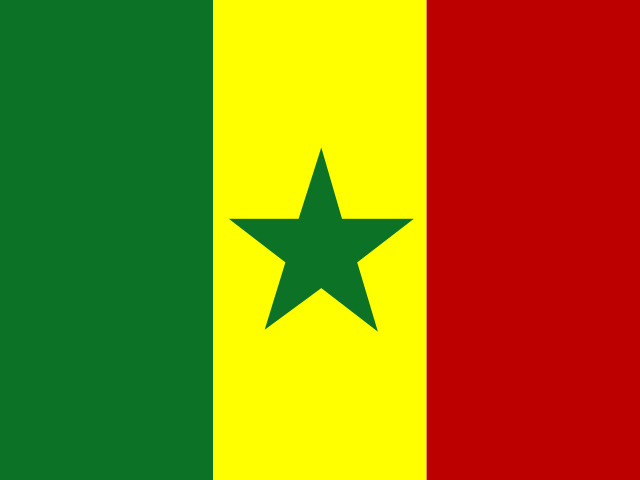
The Senegalese flag consists of three equal vertical bands of green (hoist), yellow (center) and red (fly), with a green five-pointed star centered on the yellow band. The proportion is 2:3. It was adopted on 20 August 1960, when Senegal withdrew from the Mali Federation, and has remained unchanged since.
Colors and meaning
Green represents Islam and hope for the future, yellow represents wealth and the country's mineral and agricultural resources, and red represents the blood shed for Senegalese independence and the courage of the Senegalese people. The green star represents the unity of the Senegalese people and their desire for peace and harmony.
Green
Represents Islam, the dominant religion of Senegal, and hope for the future. Green is the traditional color of Islam and appears on many Muslim national flags.
Yellow
Represents wealth, prosperity and the country's natural resources. Senegal has significant mineral reserves including phosphates, gold and zircon, as well as productive agricultural land.
Red
Represents the blood shed by Senegalese patriots in the struggle for independence from France, achieved in 1960, and the courage and vitality of the Senegalese people.
Green star
Represents the unity of the Senegalese people and their desire for peace and harmony. The five points of the star represent the five regions of Senegal at the time of independence.
History and adoption
Senegal became a French colony in the 17th century and was part of French West Africa until 1958, when it became an autonomous republic within the French Community. In 1959, Senegal joined with French Sudan (modern Mali) to form the Mali Federation, which used a flag with black human figures on a yellow-white-green tricolor. The federation dissolved in August 1960, and Senegal became fully independent on 20 August 1960. On the same day, the current flag was adopted — replacing the Mali Federation's human figures with a green star, to distinguish Senegal's flag and symbolize national unity. The design has remained unchanged since.
Key facts
- Adopted
- 20 August 1960
- Proportion
- 2:3
- Designer
- Based on the Mali Federation flag with the addition of a green star
- Capital
- Dakar
- Country code
- SN
- Similar flags
- Mali, Cameroon, Guinea
Historical and related flags
Senegal used several flags across its colonial, federal and independent periods.
- French colony (1677–1958): French flag used during colonial rule.
- Mali Federation (1959–1960): Yellow-white-green tricolor with black human figures.
- Current flag (1960–present): Green-yellow-red vertical bands with a green star.
- Naval ensign: Uses the Senegalese flag with a red anchor in the canton.
- Presidential standard: Uses the Senegalese coat of arms with a red lion.
Frequently asked questions
What does the flag of Senegal look like?
The flag of Senegal has three equal vertical bands of green (hoist), yellow (center) and red (fly), with a green five-pointed star in the center of the yellow band. The proportion is 2:3.
When was the flag of Senegal adopted?
The current flag of Senegal was officially adopted on 20 August 1960.
What do the colors mean?
Green represents Islam and hope for the future, yellow represents wealth and the country's mineral and agricultural resources, and red represents the blood shed for Senegalese independence and the courage of the Senegalese people. The green star represents the unity of the Senegalese people and their desire for peace and harmony.
Which flags look similar to the Senegal flag?
Mali uses the same green-yellow-red vertical bands but without the star. Cameroon uses green-red-yellow with a yellow star. Guinea uses red-yellow-green with a red star. Senegal's green-yellow-red with a green star is unique.

 Mali
 Guinea
 Cameroon
 Gambia
 Mauritania
 Ivory Coast