What the flag looks like
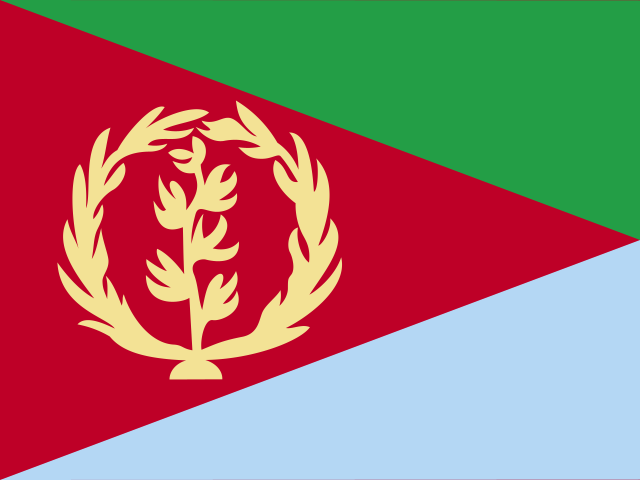
The Eritrean flag is divided by a red isosceles triangle extending from the hoist. The upper triangle is green and the lower triangle is blue. Centered on the red triangle is a golden olive wreath with 30 leaves. The proportion is 1:2. It was adopted on 5 December 1995, four years after Eritrea gained independence from Ethiopia.
Colors and meaning
Green represents the country's agricultural wealth and the fertility of the Eritrean land, blue represents the Red Sea that borders Eritrea's long coastline, red represents the blood shed during the long struggle for independence, and the golden olive wreath represents peace and the 30 years of struggle — one leaf for each year of the war for independence.
Green
Represents the agricultural wealth and fertility of the Eritrean land. Eritrea has fertile highlands and lowlands, though agriculture is limited by the country's arid climate.
Blue
Represents the Red Sea, which borders Eritrea's entire 1,300-kilometer coastline. Eritrea's name comes from the Greek 'Erythra Thalassa' (Red Sea), and the sea has been central to Eritrean identity for millennia.
Red
Represents the blood shed during Eritrea's long armed struggle for independence from Ethiopia, which lasted from 1961 to 1991 — one of the longest liberation wars in African history.
Golden olive wreath
Represents peace and the 30 years of struggle for independence — one leaf for each year of the war (1961–1991). The olive wreath is a traditional symbol of peace and victory in the Horn of Africa region.
Design origin
The flag was designed by the Eritrean People's Liberation Front (EPLF) during the independence struggle. It was used as the EPLF's banner and was adopted as the national flag on 5 December 1995, following independence in 1993.
History and adoption
Eritrea was an Italian colony from 1890 until 1941, when it was captured by British forces during World War II. From 1952 to 1962, it was federated with Ethiopia, and in 1962 Ethiopia annexed Eritrea outright. The Eritrean Liberation Front (ELF) and later the Eritrean People's Liberation Front (EPLF) fought a 30-year war for independence. In 1991, the EPLF captured Asmara, and Eritrea gained independence on 24 May 1993 following a UN-supervised referendum. The current flag was adopted on 5 December 1995, replacing the earlier design that had been used since 1993. It was designed by the EPLF during the liberation struggle and has remained unchanged since.
Key facts
- Adopted
- 5 December 1995
- Proportion
- 1:2
- Designer
- Eritrean People's Liberation Front (EPLF)
- Capital
- Asmara
- Country code
- ER
- Similar flags
- None
Historical and related flags
Eritrea used several flags during its Italian, British, Ethiopian and independence periods.
- Italian Eritrea (1890–1941): Italian colonial flags.
- British Eritrea (1941–1952): British military administration flags.
- Ethiopian federation and annexation (1952–1991): Ethiopian flag used, with Eritrean resistance flags in the field.
- EPLF flag (1970s–1991): Current design used by the liberation movement.
- First independence flag (1993–1995): Similar design, slightly different proportions.
- Current flag (1995–present): Standardized proportions and olive wreath.
Frequently asked questions
What does the flag of Eritrea look like?
The flag of Eritrea is divided into three triangles by a red isosceles triangle from the hoist. The upper triangle is green, the lower is blue, and a golden olive wreath with 30 leaves sits in the red triangle. The proportion is 1:2.
When was the flag of Eritrea adopted?
The current flag of Eritrea was officially adopted on 5 December 1995.
What do the colors mean?
Green represents the country's agricultural wealth and the fertility of the Eritrean land, blue represents the Red Sea that borders Eritrea's long coastline, red represents the blood shed during the long struggle for independence, and the golden olive wreath represents peace and the 30 years of struggle — one leaf for each year of the war for independence.
Which flags look similar to the Eritrea flag?
No other national flag closely resembles Eritrea's. The combination of green, blue and red triangles with a golden olive wreath is unique.

 Ethiopia
 Djibouti
 Sudan
 Somalia
 Yemen
 South Sudan