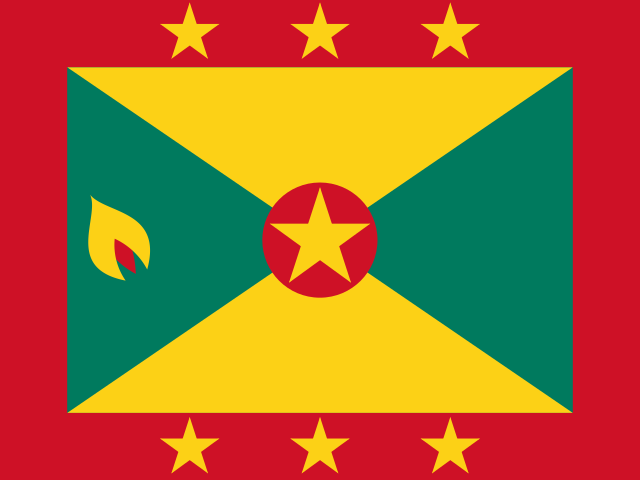
What the flag looks like
The Grenadian flag has a red border on all four sides, with the interior divided into four quarters by a yellow diagonal cross (saltire). The top and bottom quarters are yellow with a red-bordered star, and the hoist and fly quarters are green with a red-bordered star. In the center, where the diagonals cross, is a red disc bearing a golden nutmeg. The proportion is 3:5. It was adopted on 7 February 1974, when Grenada gained independence from Britain.
Colors and meaning
Red represents courage, the blood shed for Grenadian independence and the unity of the Grenadian people, green represents the island's vegetation and agriculture, and yellow represents the sun and the warmth of the Grenadian people. The six stars represent the six parishes of Grenada, and the nutmeg represents the country's most famous export — Grenada is one of the world's largest producers of nutmeg and is known as the 'Isle of Spice'.
Red border
Represents the courage of the Grenadian people, the blood shed for independence and the unity of the nation. The wide red border surrounds the entire flag and emphasizes these values.
Green quarters
Represent Grenada's lush vegetation and agricultural wealth. Grenada is known as the 'Isle of Spice' for its production of nutmeg, mace, cinnamon, cloves and other spices, and green represents this agricultural heritage.
Yellow diagonal cross
Represents the sun that shines on Grenada year-round and the warmth and friendliness of the Grenadian people. The diagonal cross divides the flag into four quarters.
Six stars
Represent the six parishes of Grenada — Saint George, Saint David, Saint Andrew, Saint Patrick, Saint Mark and Saint John. Each star is bordered in red and appears in one of the four quarters of the flag.
Nutmeg
The golden nutmeg in the center of the flag is Grenada's most famous symbol. Grenada is one of the world's largest producers of nutmeg, and the spice has been central to the island's economy since the 19th century. The nutmeg is depicted on a red disc, which represents the courage and sacrifice of the Grenadian people.
History and adoption
Grenada was a French colony from 1649 until 1763, when it was ceded to Britain after the Seven Years' War. It remained a British colony until 1974, when it gained full independence on 7 February 1974. The flag was designed by Anthony C. George, a Grenadian artist, in a national competition held in preparation for independence. It was adopted on independence day and has remained unchanged since, including through the political turbulence of the 1979–1983 period, when a Marxist government briefly took power and was overthrown by a US-led invasion.
Key facts
- Adopted
- 7 February 1974
- Proportion
- 3:5
- Designer
- Anthony C. George
- Capital
- St. George's
- Country code
- GD
- Similar flags
- None
Historical and related flags
Grenada used several flags during its French and British colonial periods before independence.
- French Grenada (1649–1763): French colonial flags.
- British Grenada (1763–1958): British Blue Ensign with a colonial badge.
- West Indies Federation (1958–1962): Blue field with four white wavy stripes and a yellow sun.
- British Grenada (1962–1967): Blue Ensign with a colonial badge.
- Associated state (1967–1974): Blue Ensign with the Grenadian coat of arms.
- Current flag (1974–present): Red border with yellow cross and central nutmeg.
- Governor-General's standard: Uses the Grenadian coat of arms on a blue field.
Frequently asked questions
What does the flag of Grenada look like?
The flag of Grenada has a red border on all four sides, with the interior divided into four quarters by a yellow diagonal cross. The top and bottom quarters are yellow with a red-bordered star each, and the hoist and fly quarters are green with a red-bordered star each. In the center is a red disc bearing a golden nutmeg. The proportion is 3:5.
When was the flag of Grenada adopted?
The current flag of Grenada was officially adopted on 7 February 1974.
What do the colors mean?
Red represents courage, the blood shed for Grenadian independence and the unity of the Grenadian people, green represents the island's vegetation and agriculture, and yellow represents the sun and the warmth of the Grenadian people. The six stars represent the six parishes of Grenada, and the nutmeg represents the country's most famous export — Grenada is one of the world's largest producers of nutmeg and is known as the 'Isle of Spice'.
Which flags look similar to the Grenada flag?
No other national flag closely resembles Grenada's. The combination of a red border with a yellow diagonal cross and a central nutmeg emblem is unique.

 Trinidad and Tobago
 Saint Vincent and the Grenadines
 Saint Lucia
 Barbados
 Venezuela
 Antigua and Barbuda