What the flag looks like
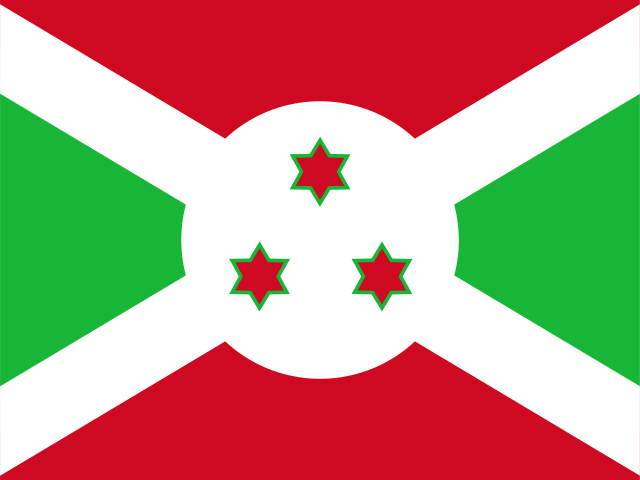
The Burundian flag consists of a white saltire (diagonal cross) dividing the field into four parts: red at the top and bottom, green at the hoist and fly. In the center, on a white disc, are three red six-pointed stars outlined in green, arranged in a triangle. The proportion is 3:5. It was adopted on 28 June 1967 and has remained unchanged except for the proportions, which were standardized in 1982.
Colors and meaning
Red represents the blood shed by Burundian patriots in the struggle for independence, white represents peace, and green represents hope and progress. The three red stars represent the three ethnic groups of Burundi — the Hutu, Tutsi and Twa — and the national motto 'Unité, Travail, Progrès' (Unity, Work, Progress).
Red
Represents the blood shed by Burundian patriots in the struggle for independence from Belgium, achieved in 1962, and the sacrifices of the Burundian people.
White
Represents peace and the desire for peaceful coexistence among all Burundians. The white saltire also represents the unity of the nation.
Green
Represents hope, progress and the natural wealth of Burundi — its forests, hills and agriculture.
Three stars
Represent the three ethnic groups of Burundi — the Hutu, Tutsi and Twa — and the three elements of the national motto: Unité (Unity), Travail (Work) and Progrès (Progress). The stars are six-pointed, outlined in green, and arranged in a triangle.
White saltire
The diagonal cross represents the unity of the nation and the peaceful coexistence of its diverse population.
History and adoption
Burundi was part of German East Africa and later a Belgian trust territory before gaining independence on 1 July 1962. The first national flag, adopted in 1962, had a white saltire dividing red and green quarters with a white disc, and inside the disc were three red stars. Between 1966 and 1967, the flag was modified — the number of stars was reduced to two, then restored to three in 1967. In 1982, the flag was standardized with the current proportions and star design. The flag has been associated with Burundi's ethnic conflict since the 1990s, but has not been changed.
Key facts
- Adopted
- 28 June 1967
- Proportion
- 3:5
- Designer
- Based on the 1962 independence flag
- Capital
- Gitega
- Country code
- BI
- Similar flags
- None
Historical and related flags
Burundi has used several flags since independence, with the number of stars changing during early political crises.
- German East Africa (1894–1916): German colonial flags.
- Belgian Ruanda-Urundi (1916–1962): Belgian colonial flags.
- First flag (1962–1966): White saltire with three red stars on a white disc.
- Second flag (1966–1967): Two stars instead of three.
- Current flag (1967–present): Three stars restored, proportions standardized in 1982.
- Presidential standard: Uses the Burundian coat of arms on a red field.
Frequently asked questions
What does the flag of Burundi look like?
The flag of Burundi is divided by a white saltire into red quarters at top and bottom and green quarters at the hoist and fly. A white disc in the center bears three red six-pointed stars outlined in green. The proportion is 3:5.
When was the flag of Burundi adopted?
The current flag of Burundi was officially adopted on 28 June 1967.
What do the colors mean?
Red represents the blood shed by Burundian patriots in the struggle for independence, white represents peace, and green represents hope and progress. The three red stars represent the three ethnic groups of Burundi — the Hutu, Tutsi and Twa — and the national motto 'Unité, Travail, Progrès' (Unity, Work, Progress).
Which flags look similar to the Burundi flag?
No other national flag closely resembles Burundi's. The combination of red and green quarters with a saltire and three stars is unique.

 Rwanda
 Tanzania
 DR Congo
 Uganda
 Kenya
 Jamaica