What the flag looks like
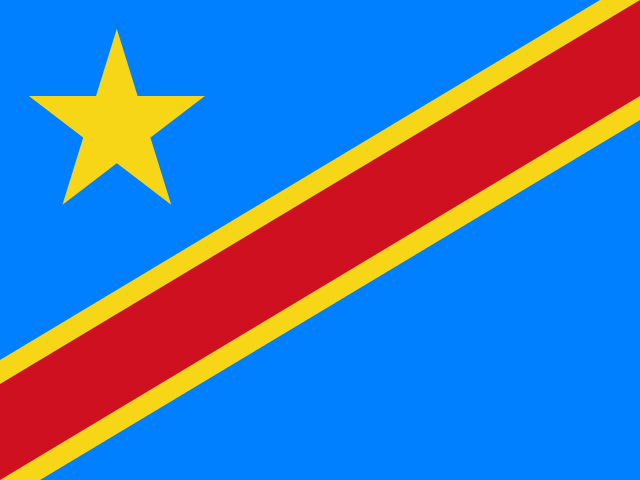
The flag of the Democratic Republic of the Congo consists of a sky-blue field with a red diagonal stripe bordered in yellow, running from the lower hoist corner to the upper fly corner. A yellow five-pointed star sits in the upper hoist corner. The proportion is 3:4. It was adopted on 20 February 2006, following the 2005 constitutional referendum, and has remained unchanged since.
Colors and meaning
Sky blue represents peace, hope and the vast territory of the Congo, red represents the blood shed by Congolese patriots in the struggle for independence, yellow represents the country's mineral wealth and prosperity, and the yellow star represents a bright future for the nation.
Sky blue
Represents peace, hope and the vast territory of the Democratic Republic of the Congo — the largest country in sub-Saharan Africa by area.
Red
Represents the blood shed by Congolese patriots in the struggle for independence and in the many conflicts that have affected the country since 1960.
Yellow
Represents the country's mineral wealth — the DR Congo is one of the world's largest producers of cobalt, copper, diamonds and gold — and the prosperity that this wealth should bring.
Yellow star
Represents a bright future for the Congolese nation and the unity of its diverse peoples.
Design origin
The design is based on the flag used from 1963 to 1971, during the First Republic, which also featured a blue field, red-yellow-red diagonal stripe and a yellow star. That flag was replaced in 1971 when the country became Zaire under Mobutu, and the current design restores the earlier look.
History and adoption
The Democratic Republic of the Congo gained independence from Belgium on 30 June 1960, initially under the name Republic of the Congo. The first flag was a blue field with a yellow star and six smaller stars. In 1963, the flag was changed to the design now in use — a blue field with a red-yellow-red diagonal stripe and a single yellow star. In 1971, President Mobutu renamed the country Zaire and adopted a green flag with a yellow disc containing a hand holding a torch. After Mobutu was overthrown in 1997, the country was renamed DR Congo and the 1963 flag was readopted. In 2006, following the 2005 constitutional referendum, the flag was standardized with the current proportions.
Key facts
- Adopted
- 20 February 2006
- Proportion
- 3:4
- Designer
- Based on the 1963–1971 flag
- Capital
- Kinshasa
- Country code
- CD
- Similar flags
- None
Historical and related flags
DR Congo has used several flags since independence, reflecting its political upheavals.
- Belgian Congo (1908–1960): Belgian flag used during colonial rule.
- Republic of the Congo (1960–1963): Blue field with a large star and six small stars.
- First Republic (1963–1971): Blue field with red-yellow stripe and a yellow star.
- Zaire (1971–1997): Green flag with a yellow disc containing a hand holding a torch.
- Post-Mobutu (1997–2003): 1963 flag readopted.
- Transitional period (2003–2006): Same flag used during transition.
- Current flag (2006–present): Standardized with current proportions.
Frequently asked questions
What does the flag of DR Congo look like?
The flag of DR Congo is a sky-blue field with a red diagonal stripe bordered in yellow running from the lower hoist to the upper fly, and a yellow five-pointed star in the upper hoist corner. The proportion is 3:4.
When was the flag of DR Congo adopted?
The current flag of DR Congo was officially adopted on 20 February 2006.
What do the colors mean?
Sky blue represents peace, hope and the vast territory of the Congo, red represents the blood shed by Congolese patriots in the struggle for independence, yellow represents the country's mineral wealth and prosperity, and the yellow star represents a bright future for the nation.
Which flags look similar to the DR Congo flag?
No other national flag closely resembles DR Congo's. The combination of a sky-blue field, red-yellow diagonal stripe and a single yellow star in the upper hoist is unique.

 Republic of the Congo
 Rwanda
 Burundi
 Uganda
 Central African Republic
 Angola