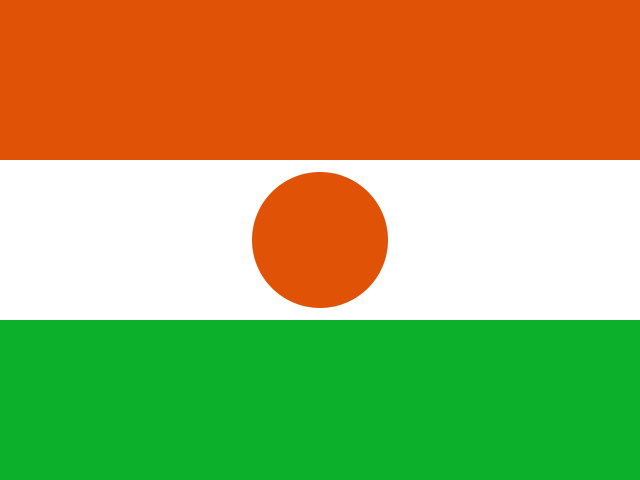
What the flag looks like
The Nigerien flag consists of three equal horizontal bands of orange (top), white (middle) and green (bottom), with an orange circle centered on the white band. The proportion is 6:7, making it one of the closest to square of any national flag. It was adopted on 23 November 1959, one year before Niger gained independence from France on 3 August 1960.
Colors and meaning
Orange represents the northern Sahara desert and the savanna grasslands, white represents purity and innocence, and green represents the fertile lands of the Niger River valley and hope for the future. The orange circle in the center represents the sun and the readiness of the Nigerien people to defend their independence.
Orange
Represents the northern Sahara Desert and the savanna grasslands of Niger. The country is largely covered by the Sahara in the north, and orange is a traditional color of the Saharan landscape.
White
Represents purity, innocence and the desire for peaceful development.
Green
Represents the fertile lands of the Niger River valley in the southwest and hope for the future. The Niger River is the lifeblood of the country, providing water for agriculture and fishing.
Orange circle
Represents the sun and, in some interpretations, the readiness of the Nigerien people to defend their independence. The circle is a traditional symbol of the sun and independence in many African cultures.
History and adoption
Niger was a French colony from 1900 until 1959, when it became an autonomous republic within the French Community. The flag was adopted on 23 November 1959, in preparation for full independence, which was granted on 3 August 1960. The design was created by a committee that included the artist Suzanne Gauthier and the politician Boubou Hama, drawing on the colors of the landscape and the Niger River. The flag has remained unchanged since independence, despite multiple coups and constitutional changes.
Key facts
- Adopted
- 23 November 1959
- Proportion
- 6:7
- Designer
- Suzanne Gauthier, Boubou Hama (design committee)
- Capital
- Niamey
- Country code
- NE
- Similar flags
- India, Ireland
Historical and related flags
Niger used several flags during its colonial period before independence.
- French Niger (1900–1959): French flag used during colonial rule.
- Autonomous republic (1959–1960): Current flag adopted.
- Current flag (1960–present): Orange, white and green with an orange circle.
- Presidential standard: Uses the Nigerien coat of arms with a zebu, a sun and crossed Tuareg swords.
Frequently asked questions
What does the flag of Niger look like?
The flag of Niger has three equal horizontal bands of orange (top), white (middle) and green (bottom), with an orange circle in the center of the white band. The proportion is 6:7, unusually close to square.
When was the flag of Niger adopted?
The current flag of Niger was officially adopted on 23 November 1959.
What do the colors mean?
Orange represents the northern Sahara desert and the savanna grasslands, white represents purity and innocence, and green represents the fertile lands of the Niger River valley and hope for the future. The orange circle in the center represents the sun and the readiness of the Nigerien people to defend their independence.
Which flags look similar to the Niger flag?
India uses saffron, white and green horizontal bands with a blue wheel in the center. Ireland uses green, white and orange vertical bands. Niger's orange-white-green horizontal with an orange circle is unique.

 Mali
 Burkina Faso
 Algeria
 Libya
 Chad
 Nigeria