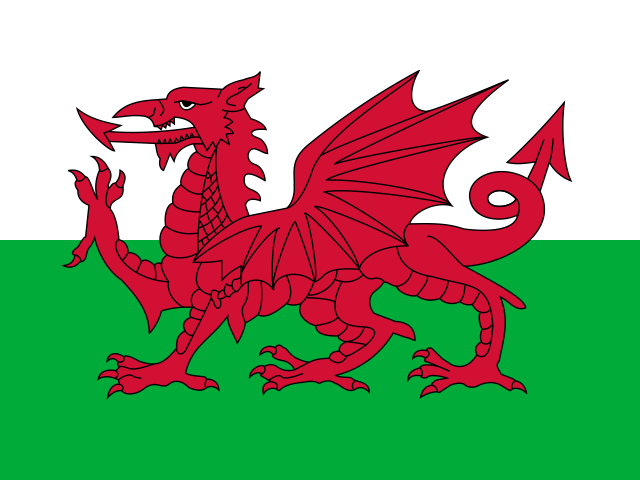
What the flag looks like
The Welsh flag consists of a white and green field divided horizontally — white on top and green on the bottom — with a large red dragon walking (passant) with one foreleg raised. The proportion is 3:5. The current design was officially adopted in 1959, though the red dragon has been associated with Wales for over 1,500 years. Wales is the only country in the world whose national flag features a dragon.
Colors and meaning
The white and green field represents the colors of the House of Tudor — the Welsh dynasty that ruled England from 1485 to 1603 — and white and green were also the colors of the Welsh flag used by Henry VII at the Battle of Bosworth. The red dragon (Y Ddraig Goch) is the ancient symbol of Wales, representing the Welsh people and their resilience, courage and independence.
White field (upper)
Represents the white in the Tudor livery, and the traditional colors of the Welsh royal houses. White is also a heraldic color of purity and peace.
Green field (lower)
Represents the green in the Tudor livery, and the green valleys and hills of Wales. Green is also associated with the leek, one of the national symbols of Wales.
Red dragon
The Y Ddraig Goch is the oldest and most important national symbol of Wales. It represents the Welsh people, their history and their resilience against conquest. The dragon has been associated with Wales since at least the 5th century and appears in the Mabinogion, the collection of medieval Welsh tales, where the red dragon fights the white dragon (representing the Saxons). The red dragon was used as a symbol by Welsh kings and princes, including Cadwaladr and Owain Glyndŵr, and was brought to prominence by Henry Tudor, who used it as one of his supporters on the royal arms when he became King Henry VII in 1485.
History and adoption
The red dragon has been associated with Wales since at least the 5th century, when it appeared in Welsh literature and on the banners of Welsh princes. In the Mabinogion, the red dragon fights the white dragon in a symbolic battle that represents the struggle between the Welsh and the Saxons. The red dragon was used by Owain Glyndŵr during his rebellion against English rule in the early 15th century and by Henry Tudor at the Battle of Bosworth in 1485. The design was used as part of the royal arms of England from 1485 until 1603, but the purely Welsh flag fell out of use after the Acts of Union. In 1953, the flag was used at the coronation of Queen Elizabeth II, and in 1959 it was officially adopted as the national flag of Wales in its current form — a red dragon on a white and green field. In 2005, the Welsh flag was granted official status in the United Kingdom, and it is now flown over government buildings in Wales on St David's Day (1 March) and other occasions.
Key facts
- Adopted
- 1959 (current design); officially recognized in the UK in 2005
- Proportion
- 3:5
- Designer
- Based on the historic Welsh dragon design; current version standardized by the College of Arms
- Capital
- Cardiff
- Country code
- GB-WLS
- Similar flags
- Bhutan, Malta
Historical and related flags
Wales has used several flags across its history, and related symbols are in use today.
- Royal Standard of Wales (medieval): Four lions passant on a quartered gold and red field, used by the Princes of Gwynedd.
- Owain Glyndŵr's banner (1400–1415): Four lions on a quartered gold and red field, used during the Welsh rebellion.
- Tudor dragon (1485–1603): Red dragon on a white and green field, used as a supporter of the English royal arms.
- Modern Welsh flag (1959–present): Red dragon on a white and green field.
- Flag of St David: A yellow cross on a black field, used by some Welsh Christians and traditionally flown on St David's Day.
- Welsh Dragon (Y Ddraig Goch): The current design, in use across Wales.
Frequently asked questions
What does the flag of Wales look like?
The flag of Wales, known as Y Ddraig Goch (the Red Dragon), is a white and green field with a large red dragon passant in the center. The proportion is 3:5.
When was the flag of Wales adopted?
The current flag of Wales was officially adopted on 1959 (current design); officially recognized in the UK in 2005.
What do the colors mean?
The white and green field represents the colors of the House of Tudor — the Welsh dynasty that ruled England from 1485 to 1603 — and white and green were also the colors of the Welsh flag used by Henry VII at the Battle of Bosworth. The red dragon (Y Ddraig Goch) is the ancient symbol of Wales, representing the Welsh people and their resilience, courage and independence.
Which flags look similar to the Wales flag?
Bhutan uses a white dragon on a diagonal yellow and orange field. Wales uses a red dragon on a horizontal white and green field. The two flags are distinct, though both feature dragons — Wales's is the only one with a red dragon.

 United Kingdom
 England
 Scotland
 Northern Ireland
 Ireland
 European Union