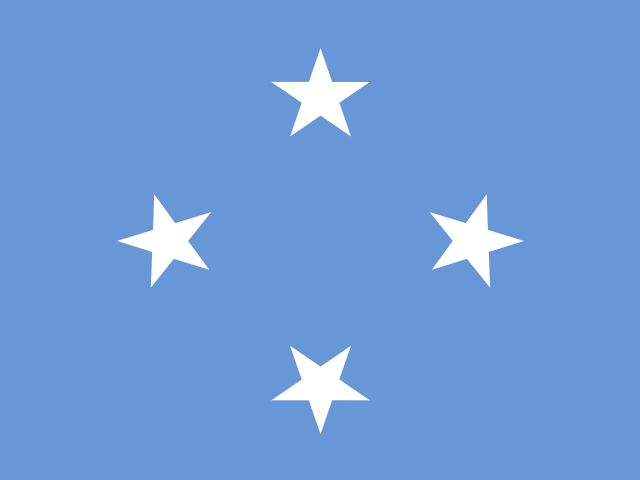
What the flag looks like
The Micronesian flag consists of a light blue field with four white five-pointed stars arranged in a diamond pattern in the center. The proportion is 10:19. It was adopted on 10 November 1978, when the Federated States of Micronesia became a self-governing territory, and was retained when the country gained full independence in 1986 under a Compact of Free Association with the United States.
Colors and meaning
The light blue field represents the Pacific Ocean that surrounds the Micronesian islands, and the four white five-pointed stars represent the four states that make up the federation — Chuuk, Kosrae, Pohnpei and Yap.
Light blue field
Represents the Pacific Ocean that surrounds the Federated States of Micronesia — an archipelago of over 600 islands scattered across about 2.6 million square kilometers of ocean, but with a total land area of only 702 square kilometers. Light blue also represents the sky over the islands.
Four white stars
Represent the four states that make up the federation — Chuuk, Kosrae, Pohnpei and Yap. The stars are arranged in a diamond (rhombus) pattern, symbolizing the geographic arrangement of the four states. Each star is five-pointed and white, representing peace, hope and the unity of the Micronesian people. The four states were originally part of the Trust Territory of the Pacific Islands, and each has its own distinct language and culture.
Design origin
The flag was designed in a competition in 1978, when the Federated States of Micronesia was established as a self-governing territory within the US-administered Trust Territory of the Pacific Islands. The light blue field and four stars were chosen to represent the Pacific Ocean and the four constituent states. The design was adopted on 10 November 1978, and was retained when Micronesia became fully independent on 3 November 1986.
History and adoption
Micronesia was part of the Spanish East Indies from the 16th century until 1899, when it was sold to Germany after the Spanish–American War. It was occupied by Japan during World War I and administered by Japan as a League of Nations mandate from 1919 until 1944. After World War II, it became part of the United States-administered Trust Territory of the Pacific Islands. On 10 May 1979, four districts of the Trust Territory — Chuuk, Kosrae, Pohnpei and Yap — ratified a constitution and formed the Federated States of Micronesia. The flag was adopted on 10 November 1978, before the constitution took effect, and has remained unchanged since. Micronesia became fully independent on 3 November 1986 under a Compact of Free Association with the United States.
Key facts
- Adopted
- 10 November 1978
- Proportion
- 10:19
- Designer
- Based on a design submitted in a national competition
- Capital
- Palikir
- Country code
- FM
- Similar flags
- None
Historical and related flags
Micronesia used several flags during its Spanish, German, Japanese and American periods before self-government.
- Spanish East Indies (1521–1899): Spanish colonial flags.
- German New Guinea (1899–1914): German colonial flags.
- Japanese South Seas Mandate (1919–1944): Japanese flag used.
- US Trust Territory (1947–1978): United States flag and Trust Territory flag used.
- Current flag (1978–present): Light blue field with four white stars.
- State flags: Chuuk, Kosrae, Pohnpei and Yap each have their own state flags.
Frequently asked questions
What does the flag of Micronesia look like?
The flag of Micronesia is a light blue field with four white five-pointed stars arranged in a diamond pattern in the center. The proportion is 10:19.
When was the flag of Micronesia adopted?
The current flag of Micronesia was officially adopted on 10 November 1978.
What do the colors mean?
The light blue field represents the Pacific Ocean that surrounds the Micronesian islands, and the four white five-pointed stars represent the four states that make up the federation — Chuuk, Kosrae, Pohnpei and Yap.
Which flags look similar to the Micronesia flag?
No other national flag closely resembles Micronesia's. The combination of a light blue field with four white stars in a diamond pattern is unique, though the flag of the Marshall Islands also uses a light blue field with stars.

 Marshall Islands
 Palau
 Nauru
 Kiribati
 Solomon Islands
 Papua New Guinea