What the flag looks like
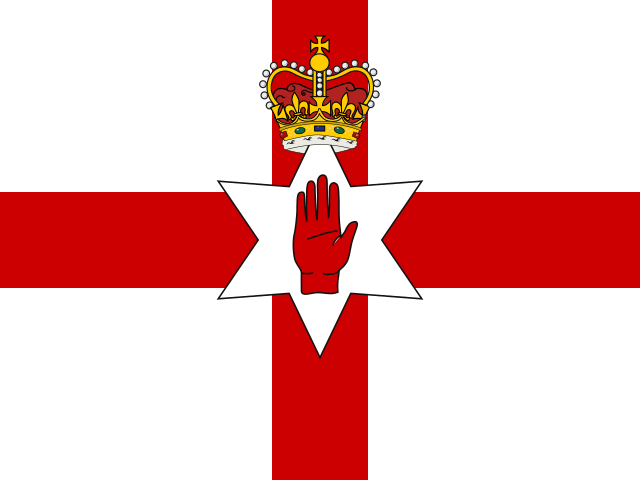
The Ulster Banner consists of a white field with a red cross of St George. In the center is a white six-pointed star bearing the Red Hand of Ulster, surmounted by a royal crown. The proportion is 2:3. It was used as the official flag of Northern Ireland from 1953 to 1972, when the Northern Ireland Parliament was suspended and later abolished. Since then, Northern Ireland has had no official flag, and the Ulster Banner is used unofficially — mostly by unionist and loyalist communities and by Northern Ireland's sporting teams at international events.
Colors and meaning
The white field and red cross derive from the St George's Cross, the flag of England, and represent Northern Ireland's link to England. The six-pointed star represents the six counties of Northern Ireland, the Red Hand of Ulster represents the province of Ulster, and the crown represents the British monarchy. The design is broadly associated with unionism and loyalism and is not accepted by many nationalists and republicans.
White field and red cross
Derived from the St George's Cross, the flag of England, and represent Northern Ireland's constitutional and cultural link to England. The red cross on a white field is one of the oldest heraldic symbols in Europe.
Six-pointed star
Represents the six counties of Northern Ireland — Antrim, Armagh, Down, Fermanagh, Londonderry (Derry) and Tyrone. The star has six points, unlike the five-pointed stars used in most heraldry, to reflect the six counties.
Red Hand of Ulster
The red right hand is the ancient symbol of the province of Ulster and the O'Neill dynasty. According to legend, the symbol originated when two chieftains raced to be the first to touch the shore of Ulster, and one cut off his hand and threw it ashore to win the race. The Red Hand has been used as a symbol of Ulster since the 13th century.
Crown
Represents the British monarchy and Northern Ireland's constitutional status as part of the United Kingdom. The crown is a traditional symbol of British royal authority.
Contested status
The Ulster Banner is used primarily by unionist and loyalist communities and is not recognized by many nationalists and republicans, who favor the Irish tricolor or a neutral flag. Northern Ireland has had no official flag since 1973, and the Ulster Banner is used unofficially at sporting events and by unionist organizations.
History and adoption
Northern Ireland was created in 1921 when the island of Ireland was partitioned, with the six northeastern counties remaining part of the United Kingdom. The Government of Ireland Act 1920 provided for a Northern Ireland Parliament, and from 1924 the Parliament used a flag based on the St George's Cross with the Red Hand of Ulster and the Northern Ireland coat of arms. In 1953, the Ulster Banner was officially adopted as the flag of Northern Ireland. In 1972, the Northern Ireland Parliament was suspended, and in 1973 it was abolished, leaving Northern Ireland without a legislature and without an official flag. Several attempts have been made to establish a new, neutral flag that would be acceptable to both unionists and nationalists, but none have succeeded. Today, the Ulster Banner remains the most widely recognized flag associated with Northern Ireland, but it is used primarily by the unionist community and is not recognized as a neutral symbol for the whole region.
Key facts
- Adopted
- 1953 (official); 1973 (no longer official)
- Proportion
- 2:3
- Designer
- Based on the historic coat of arms of Northern Ireland (1924)
- Capital
- Belfast
- Country code
- GB-NIR
- Similar flags
- England
Historical and related flags
Northern Ireland has used several flags across its history, and several related symbols are in use today.
- Ulster flag (medieval): Red cross on white with the Red Hand of Ulster, used as the emblem of the province of Ulster.
- Government of Northern Ireland (1924–1953): Used the Northern Ireland coat of arms.
- Ulster Banner (1953–1972): Official flag of Northern Ireland.
- Ulster Banner (1972–present): Unofficial flag, used by unionists and sporting teams.
- Flag of Ireland (Irish tricolor): Used by nationalists and republicans in Northern Ireland.
- Union Jack: Used officially across the United Kingdom, including Northern Ireland.
Frequently asked questions
What does the flag of Northern Ireland look like?
Northern Ireland has no official flag since 1973. The Ulster Banner — a white field with a red cross, a six-pointed star bearing the Red Hand of Ulster and a crown — was the official flag from 1953 to 1972 and remains the most widely recognized unofficial flag of Northern Ireland.
When was the flag of Northern Ireland adopted?
The current flag of Northern Ireland was officially adopted on 1953 (official); 1973 (no longer official).
What do the colors mean?
The white field and red cross derive from the St George's Cross, the flag of England, and represent Northern Ireland's link to England. The six-pointed star represents the six counties of Northern Ireland, the Red Hand of Ulster represents the province of Ulster, and the crown represents the British monarchy. The design is broadly associated with unionism and loyalism and is not accepted by many nationalists and republicans.
Which flags look similar to the Northern Ireland flag?
The Ulster Banner is based on the St George's Cross of England but adds the six-pointed star, the Red Hand of Ulster and a crown. It is sometimes confused with the flag of England, but the two are distinct — England's flag has no additional emblems.

 United Kingdom
 England
 Scotland
 Wales
 Ireland
 European Union