What the flag looks like
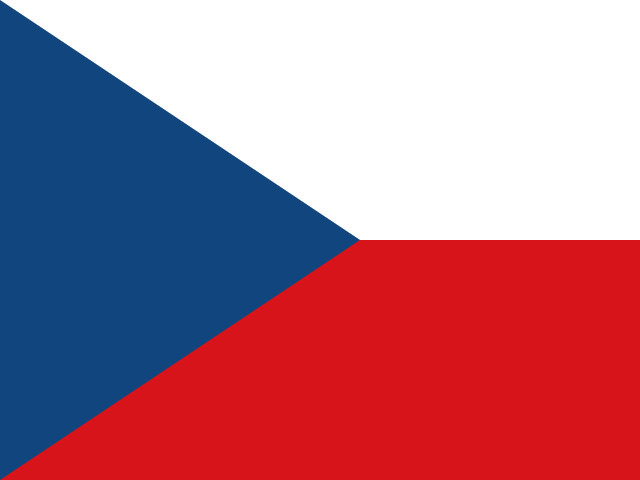
The Czech flag consists of a white horizontal band on top, a red horizontal band on the bottom, and a blue isosceles triangle at the hoist whose apex reaches to the center of the flag. The proportion is 2:3. It was adopted on 30 March 1920 as the flag of Czechoslovakia and was retained by Czechia after the peaceful dissolution of Czechoslovakia on 1 January 1993.
Colors and meaning
White represents peace and honesty, red represents the blood shed for Czech independence, and blue represents Slovakia, added when the flag was designed for the new state of Czechoslovakia in 1920. The colors are derived from the historical coat of arms of Bohemia, a white double-tailed lion on a red field.
White
Represents peace, purity and the white of the Bohemian lion on the historical coat of arms.
Red
Represents the blood shed for Czech independence and the field color of the Bohemian coat of arms.
Blue
Added when the flag was created for Czechoslovakia in 1920 to represent Slovakia, whose historical colors were white, blue and red. The blue triangle was chosen to distinguish the new flag from Poland's similar white-and-red bicolor.
Bohemian lion
The white double-tailed lion on a red field is the historical coat of arms of Bohemia, used since the 13th century.
History and adoption
The Czechoslovak flag was adopted on 30 March 1920, two years after Czechoslovakia was formed from the Austro-Hungarian Empire. The original design was a white-and-red bicolor based on the Bohemian coat of arms, but this was identical to the Polish flag, so a blue triangle was added to represent Slovakia. During the Nazi occupation (1939–1945), the flag was banned and the Protectorate of Bohemia and Moravia used a white-and-red tricolor. The flag was restored after the war and used by communist Czechoslovakia until 1989. When Czechoslovakia split on 1 January 1993, Czechia retained the flag, while Slovakia adopted a new one. Slovakia objected at the time, but Czechia kept the flag as its national symbol.
Key facts
- Adopted
- 30 March 1920
- Proportion
- 2:3
- Designer
- Jaroslav Kursa
- Capital
- Prague
- Country code
- CZ
- Similar flags
- Philippines, Poland
Historical and related flags
Czechia's flag history is closely tied to Czechoslovakia's, with several interruptions during occupation and war.
- Bohemian coat of arms (13th century–1918): White double-tailed lion on red.
- Czechoslovakia (1920–1939): Current design adopted for the new state.
- Protectorate of Bohemia and Moravia (1939–1945): White-red tricolor used under German occupation.
- Czechoslovak Socialist Republic (1948–1990): Flag used without change.
- Czech and Slovak Federative Republic (1990–1992): Same flag used until the split.
- Czechia (1993–present): Flag retained after dissolution of Czechoslovakia.
Frequently asked questions
What does the flag of Czechia look like?
The flag of Czechia has a white band on top, a red band on the bottom, and a blue triangle at the hoist side. The proportion is 2:3.
When was the flag of Czechia adopted?
The current flag of Czechia was officially adopted on 30 March 1920.
What do the colors mean?
White represents peace and honesty, red represents the blood shed for Czech independence, and blue represents Slovakia, added when the flag was designed for the new state of Czechoslovakia in 1920. The colors are derived from the historical coat of arms of Bohemia, a white double-tailed lion on a red field.
Which flags look similar to the Czechia flag?
The Philippines uses a similar design with a white triangle at the hoist and blue and red bands. Poland uses a plain white-and-red bicolor. Czechia's blue triangle distinguishes it from both.

 Slovakia
 Poland
 Austria
 Germany
 Philippines
 Hungary