What the flag looks like
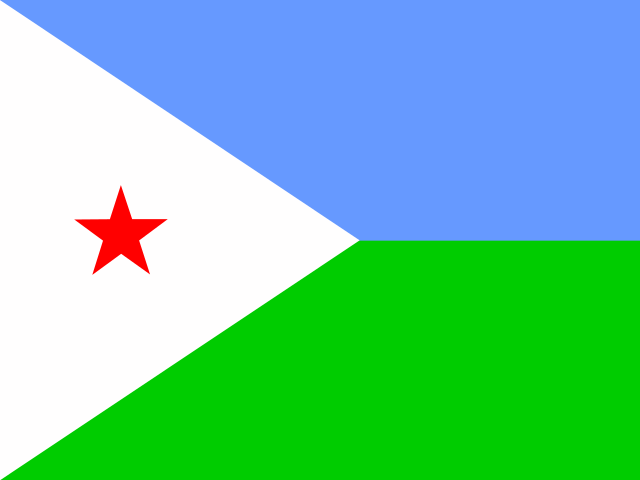
The Djiboutian flag consists of two equal horizontal bands of light blue (top) and green (bottom), with a white isosceles triangle at the hoist containing a red five-pointed star. The proportion is 2:3. It was adopted on 27 June 1977, when Djibouti gained independence from France.
Colors and meaning
Light blue represents the sky and the waters of the Gulf of Tadjoura and the Indian Ocean, green represents the earth and the country's vegetation, white represents peace and purity, and the red star represents unity and the blood shed in the struggle for independence. The light blue also represents the Issa Somali people and the green the Afar people — the two main ethnic groups of Djibouti.
Light blue
Represents the sky over Djibouti and the waters of the Gulf of Tadjoura, which lies at the entrance to the Red Sea. Light blue is also the traditional color of the Issa Somali people, one of the two main ethnic groups of Djibouti.
Green
Represents the earth and the vegetation of Djibouti. Green is also the traditional color of the Afar people, the other main ethnic group of Djibouti.
White triangle
Represents peace and the desire for peaceful coexistence between the Issa and Afar peoples, who together make up the country's population. The white triangle unites the blue and green bands, symbolizing national unity.
Red star
Represents unity among the diverse peoples of Djibouti, and the blood shed by Djiboutian patriots in the struggle for independence from France, achieved in 1977.
History and adoption
Djibouti was a French colony known as French Somaliland from 1884 until 1967, when it was renamed the French Territory of the Afars and the Issas. The territory gained independence on 27 June 1977, becoming the Republic of Djibouti. The flag was designed by Mahamoud Harbi, a Djiboutian politician, and was adopted on independence day. It draws on the colors of the two main ethnic groups — the Issa (light blue) and the Afar (green) — with a white triangle and red star to symbolize unity and independence. The flag has remained unchanged since.
Key facts
- Adopted
- 27 June 1977
- Proportion
- 2:3
- Designer
- Mahamoud Harbi
- Capital
- Djibouti City
- Country code
- DJ
- Similar flags
- None
Historical and related flags
Djibouti used several flags during its French colonial period before independence.
- French Somaliland (1884–1967): French flag used during colonial rule.
- French Territory of the Afars and the Issas (1967–1977): French flag used during the transitional period.
- Current flag (1977–present): Light blue and green bands with a white triangle and red star.
- Presidential standard: Uses the Djiboutian coat of arms with two camels and a ship.
Frequently asked questions
What does the flag of Djibouti look like?
The flag of Djibouti has two horizontal bands of light blue (top) and green (bottom), with a white isosceles triangle at the hoist bearing a red five-pointed star. The proportion is 2:3.
When was the flag of Djibouti adopted?
The current flag of Djibouti was officially adopted on 27 June 1977.
What do the colors mean?
Light blue represents the sky and the waters of the Gulf of Tadjoura and the Indian Ocean, green represents the earth and the country's vegetation, white represents peace and purity, and the red star represents unity and the blood shed in the struggle for independence. The light blue also represents the Issa Somali people and the green the Afar people — the two main ethnic groups of Djibouti.
Which flags look similar to the Djibouti flag?
No other national flag closely resembles Djibouti's. The combination of light blue and green horizontal bands with a white hoist triangle and a red star is unique.

 Somalia
 Ethiopia
 Eritrea
 Sudan
 Yemen
 France