What the flag looks like
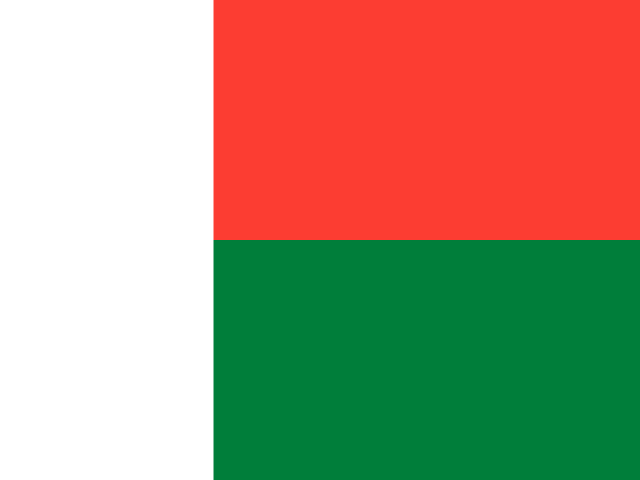
The Malagasy flag consists of a vertical white band on the hoist side, with two horizontal bands of red (top) and green (bottom) on the fly side. The proportion is 2:3. It was adopted on 14 October 1958, two years before Madagascar gained full independence from France on 26 June 1960.
Colors and meaning
White represents purity and the traditional white clothing worn by Malagasy people, red represents sovereignty, courage and the blood shed for independence, and green represents hope and the country's lush vegetation. The colors also reflect the historical kingdoms of Madagascar — red and white were the colors of the Merina Kingdom, and green was associated with the coastal peoples.
White
Represents purity, hope and the traditional white clothing worn by Malagasy people. White was the color of the Merina Kingdom's royal standard and is also associated with the country's highland population.
Red
Represents sovereignty, courage and the blood shed by Malagasy patriots in the struggle for independence, particularly during the 1947 Malagasy Uprising against French colonial rule, in which tens of thousands died.
Green
Represents hope and Madagascar's lush tropical vegetation. The country is home to some of the most unique plant and animal species in the world, found nowhere else on Earth.
Historical origin
The colors were used by the Merina Kingdom and the last queen, Ranavalona III, whose royal standard combined red and white. Green was added to represent the coastal peoples and the country's vegetation, symbolizing the unity of Madagascar's diverse population.
History and adoption
Madagascar was a French colony from 1896 until 1958, when it became an autonomous republic within the French Community. The flag was adopted on 14 October 1958, two years before full independence on 26 June 1960. The design was created by combining the traditional red and white colors of the Merina Kingdom — which ruled much of Madagascar in the 19th century — with green to represent the coastal peoples and the country's vegetation. The flag has remained unchanged since independence, through the socialist period (1975–1992) and the subsequent transition to democracy.
Key facts
- Adopted
- 14 October 1958
- Proportion
- 2:3
- Designer
- Based on the Merina Kingdom royal standard
- Capital
- Antananarivo
- Country code
- MG
- Similar flags
- None
Historical and related flags
Madagascar used several flags across its pre-colonial, French colonial and independence periods.
- Merina Kingdom (1817–1896): Red and white flag with the royal crest.
- French Madagascar (1896–1958): French flag used during colonial rule.
- Autonomous republic (1958–1960): Current flag adopted.
- Democratic Republic of Madagascar (1975–1992): Same flag retained under socialist government.
- Current flag (1992–present): Same flag under the Third Republic and beyond.
- Presidential standard: Uses the Malagasy coat of arms with a baobab tree.
Frequently asked questions
What does the flag of Madagascar look like?
The flag of Madagascar has a vertical white band on the hoist side and two horizontal bands of red (top) and green (bottom) on the fly. The proportion is 2:3.
When was the flag of Madagascar adopted?
The current flag of Madagascar was officially adopted on 14 October 1958.
What do the colors mean?
White represents purity and the traditional white clothing worn by Malagasy people, red represents sovereignty, courage and the blood shed for independence, and green represents hope and the country's lush vegetation. The colors also reflect the historical kingdoms of Madagascar — red and white were the colors of the Merina Kingdom, and green was associated with the coastal peoples.
Which flags look similar to the Madagascar flag?
No other national flag closely resembles Madagascar's. The combination of a vertical white hoist band with horizontal red and green fly bands is unique.

 Mauritius
 Seychelles
 Comoros
 Mozambique
 France
 Italy