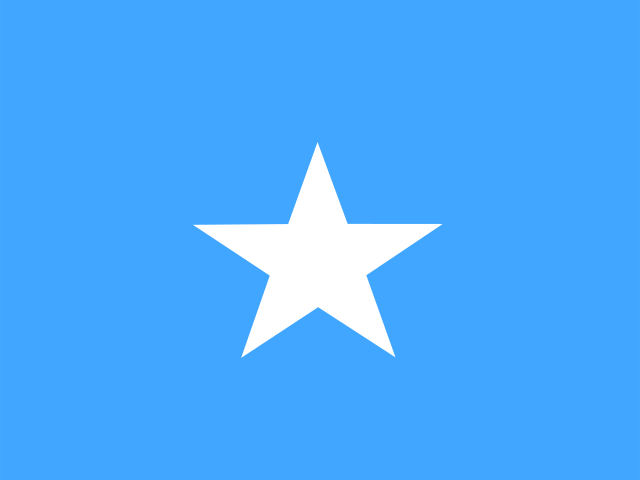
What the flag looks like
The Somali flag consists of a light blue field with a single white five-pointed star centered on it. The proportion is 2:3. It was adopted on 1 July 1960, when British Somaliland and Italian Somaliland united to form the Somali Republic, and it has remained unchanged since despite decades of civil conflict.
Colors and meaning
Light blue represents the sky over Somalia and the Indian Ocean that borders the country, and was inspired by the flag of the United Nations, which administered Italian Somaliland before independence. The white star represents the five historical regions where Somalis live: Italian Somaliland, British Somaliland, French Somaliland (Djibouti), the Ogaden region of Ethiopia and the Northern Frontier District of Kenya.
Light blue
Represents the sky over Somalia and the Indian Ocean that borders the country to the east. The color was inspired by the flag of the United Nations, which administered Italian Somaliland from 1950 to 1960 as a trust territory, and which shares the same light blue field.
White star
The five-pointed white star represents the five historical regions where ethnic Somalis live: Italian Somaliland, British Somaliland, French Somaliland (modern Djibouti), the Ogaden region of Ethiopia, and the Northern Frontier District of Kenya. The star symbolizes the aspiration of Greater Somalia — the idea of uniting all Somali-populated territories into one nation — a concept that has shaped Somali politics since independence.
Design origin
The flag was designed by Mohammed Awale Liban, a Somali scholar, in 1954, and was first used by the Somali Youth League, the leading independence movement. It was adopted as the national flag on 1 July 1960.
History and adoption
Somalia gained independence on 1 July 1960, when the former British Somaliland (independent on 26 June 1960) and Italian Somaliland united to form the Somali Republic. The flag, designed by Mohammed Awale Liban in 1954, was adopted on the day of unification and has remained unchanged since. Despite the Somali Civil War that began in 1991 and the collapse of the central government, the flag has continued to be used by various Somali governments and remains the internationally recognized national flag. In 2012, the Federal Government of Somalia was established and retained the same flag.
Key facts
- Adopted
- 1 July 1960
- Proportion
- 2:3
- Designer
- Mohammed Awale Liban
- Capital
- Mogadishu
- Country code
- SO
- Similar flags
- United Nations, Honduras, Micronesia
Historical and related flags
Somalia has used several flags across its colonial and post-independence periods.
- Italian Somaliland (1889–1941): Italian flag used during colonial rule.
- British Somaliland (1884–1960): British Blue Ensign with a colonial badge.
- Italian Trust Territory (1950–1960): United Nations flag used during trusteeship.
- Current flag (1960–present): Light blue field with a white star.
- Somaliland (1991–present): Unrecognized state uses a different flag with Islamic shahada.
- Puntland (1998–present): Autonomous region with its own flag.
Frequently asked questions
What does the flag of Somalia look like?
The flag of Somalia is a light blue field with a white five-pointed star in the center. The proportion is 2:3.
When was the flag of Somalia adopted?
The current flag of Somalia was officially adopted on 1 July 1960.
What do the colors mean?
Light blue represents the sky over Somalia and the Indian Ocean that borders the country, and was inspired by the flag of the United Nations, which administered Italian Somaliland before independence. The white star represents the five historical regions where Somalis live: Italian Somaliland, British Somaliland, French Somaliland (Djibouti), the Ogaden region of Ethiopia and the Northern Frontier District of Kenya.
Which flags look similar to the Somalia flag?
The United Nations, Honduras, and Micronesia also use light blue fields. Honduras and Micronesia add white stars, but in different arrangements. Somalia's single white star on a light blue field, shared with the UN flag, is unique among national flags.

 Ethiopia
 Kenya
 Djibouti
 United Nations
 Micronesia
 Honduras