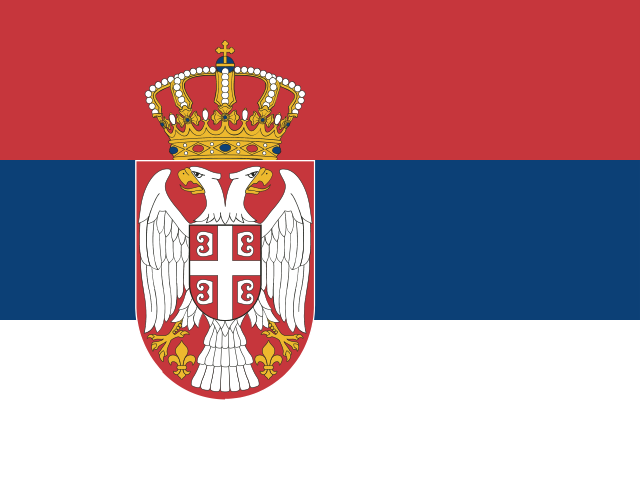
What the flag looks like
The Serbian flag consists of three equal horizontal bands of red (top), blue (middle) and white (bottom), with the Serbian coat of arms positioned toward the hoist side and centered vertically on the middle band. The coat of arms features a white double-headed eagle with a red shield bearing a white cross and four firesteels. The proportion is 2:3.
Colors and meaning
Red, blue and white are the Pan-Slavic colors adopted by Serbia in the 19th century. Red represents the blood shed for Serbian independence, blue represents freedom and the sky, and white represents peace and purity. The coat of arms includes the white double-headed eagle, symbol of the medieval Serbian Empire, and the Serbian cross with four firesteels.
Red
Represents the blood shed for Serbian independence and the courage of the Serbian people. Red is the field color of the medieval Serbian coat of arms.
Blue
Represents freedom, truth and the sky. It is one of the three Pan-Slavic colors, adopted during the 19th-century Slavic national revival.
White
Represents peace, purity and honesty, and the white double-headed eagle of the Serbian coat of arms.
Double-headed eagle
The white double-headed eagle has been a Serbian symbol since the Nemanjić dynasty in the 12th century. It represents the unity of church and state and the reach of the medieval Serbian Empire.
Serbian cross
The white cross with four firesteels (ocila) on a red shield is the oldest Serbian national symbol, used since the 14th century. The four firesteels represent the four evangelists or the four corners of the world.
History and adoption
The red-blue-white tricolor was first used by Serbian revolutionaries during the First Serbian Uprising against Ottoman rule in 1804. It was formally adopted by the Principality of Serbia in 1835, inspired by the Russian flag and Pan-Slavic colors. Serbia used the tricolor as the flag of the Kingdom of Serbia (1882–1918), the Kingdom of Yugoslavia (1918–1941) and the Socialist Federal Republic of Yugoslavia (with a red star). After the breakup of Yugoslavia, the Federal Republic of Yugoslavia (1992–2003) and later Serbia and Montenegro (2003–2006) used variants of the tricolor. The current design was formally adopted on 11 November 2010, restoring the coat of arms without the communist star.
Key facts
- Adopted
- 11 November 2010
- Proportion
- 2:3
- Designer
- Traditional — based on medieval Serbian heraldry
- Capital
- Belgrade
- Country code
- RS
- Similar flags
- Slovakia, Slovenia, Russia
Historical and related flags
Serbia has used several national flags across its revolutionary, monarchic, Yugoslav and modern periods.
- First Serbian Uprising (1804–1813): Red-blue-white tricolor first used by revolutionaries.
- Principality of Serbia (1835–1882): Tricolor with the Serbian coat of arms.
- Kingdom of Serbia (1882–1918): Tricolor with the royal coat of arms.
- Kingdom of Yugoslavia (1918–1941): Blue-white-red tricolor reversed, with the royal arms.
- SFR Yugoslavia (1945–1992): Yugoslav tricolor with a red star.
- Current flag (2010–present): Red-blue-white tricolor with the Serbian coat of arms.
Frequently asked questions
What does the flag of Serbia look like?
The flag of Serbia has three equal horizontal bands of red (top), blue (middle) and white (bottom), with the Serbian coat of arms shifted toward the hoist. The proportion is 2:3.
When was the flag of Serbia adopted?
The current flag of Serbia was officially adopted on 11 November 2010.
What do the colors mean?
Red, blue and white are the Pan-Slavic colors adopted by Serbia in the 19th century. Red represents the blood shed for Serbian independence, blue represents freedom and the sky, and white represents peace and purity. The coat of arms includes the white double-headed eagle, symbol of the medieval Serbian Empire, and the Serbian cross with four firesteels.
Which flags look similar to the Serbia flag?
Slovakia and Slovenia use the same red-blue-white tricolor with their own coats of arms. Russia uses white-blue-red — the reverse of Serbia's. The Serbian double-headed eagle distinguishes it from all of them.

 Croatia
 Slovakia
 Slovenia
 Bosnia and Herzegovina
 Montenegro
 North Macedonia