What the flag looks like
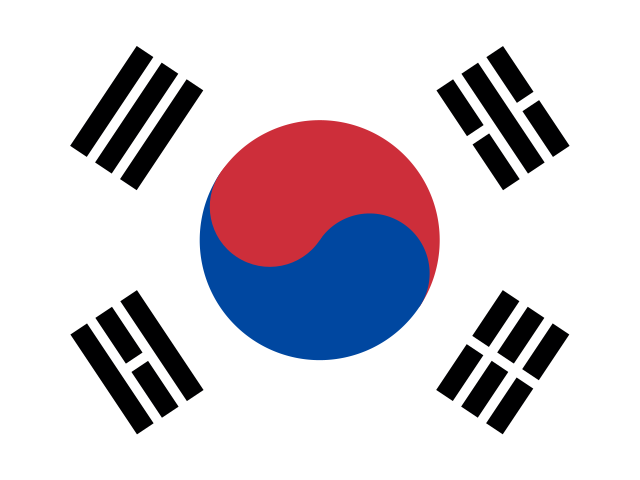
The South Korean flag, known as the Taegeukgi, consists of a white field with a central red-and-blue circular symbol called the Taegeuk, and four black trigrams (gwae) arranged in the corners. The proportion is 2:3. It was adopted on 15 October 1949, following the founding of the Republic of Korea in 1948.
Colors and meaning
White represents peace and purity, the red and blue Taegeuk represents the cosmic forces of yin and yang — balance and harmony — and the four black trigrams represent the fundamental elements of the universe: heaven, earth, fire and water.
White
Represents peace, purity and the traditional Korean color of the common people. It is also the color of the Korean national costume, the hanbok.
Red (upper Taegeuk)
Represents the positive cosmic force of yang — light, heat, activity and the sky.
Blue (lower Taegeuk)
Represents the negative cosmic force of yin — dark, cold, passivity and the earth.
Trigrams (gwae)
The four black trigrams in the corners represent: Geon (heaven, three solid lines), Gon (earth, three broken lines), Gam (water, broken-solid-broken) and Ri (fire, solid-broken-solid). Together they symbolize the balance of universal forces.
History and adoption
The Taegeukgi design was first created in 1882 during the Joseon dynasty, when Korean envoys were sent to Japan and needed a national flag. The original design was created by Park Yeong-hyo, based on traditional Korean symbols. It was used by the Korean Empire from 1883 until Japanese annexation in 1910. After the founding of the Republic of Korea in 1948, the flag was formally adopted on 15 October 1949, with the exact shades and proportions standardized. The current design was confirmed by law in 2007.
Key facts
- Adopted
- 15 October 1949
- Proportion
- 2:3
- Designer
- Park Yeong-hyo (original design), Lee Eung-jun (later refinements)
- Capital
- Seoul
- Country code
- KR
- Similar flags
- North Korea, Mongolia
Historical and related flags
Korea has used several flags during its dynastic, imperial and modern periods.
- Joseon dynasty (pre-1882): No official national flag; used royal and military banners.
- Korean Empire (1883–1910): First national Taegeukgi adopted.
- Japanese occupation (1910–1945): The Taegeukgi banned; Japanese flag used.
- People's Republic of Korea (1945–1948): Taegeukgi used provisionally.
- Republic of Korea (1948–present): Current flag adopted in 1949.
Frequently asked questions
What does the flag of South Korea look like?
The flag of South Korea has a white field with a red and blue circular Taegeuk symbol in the center and four black trigrams in the corners.
When was the flag of South Korea adopted?
The current flag of South Korea was officially adopted on 15 October 1949.
What do the colors mean?
White represents peace and purity, the red and blue Taegeuk represents the cosmic forces of yin and yang — balance and harmony — and the four black trigrams represent the fundamental elements of the universe: heaven, earth, fire and water.
Which flags look similar to the South Korea flag?
North Korea uses a red band with a white circle and red star. Mongolia uses vertical red-blue-red bands with the Soyombo symbol. South Korea's Taegeuk and trigrams are unique.

 Japan
 North Korea
 China
 Vietnam
 Mongolia
 Philippines