What the flag looks like
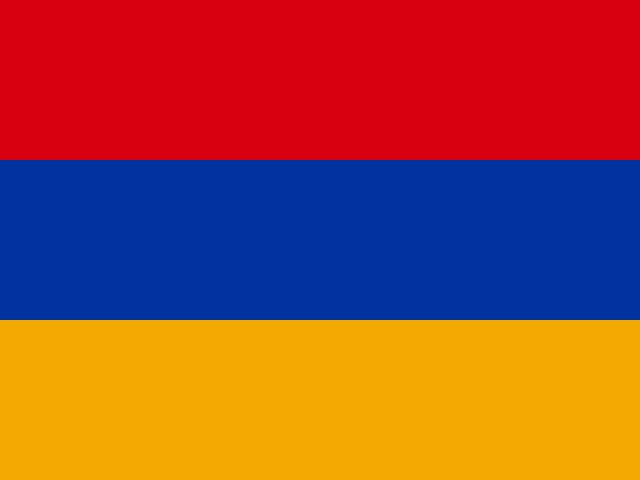
The Armenian flag consists of three equal horizontal bands of red (top), blue (middle) and orange (bottom). The proportion is 1:2. It was adopted on 24 August 1990, shortly before Armenia declared independence from the Soviet Union, and has remained unchanged since. The design was originally used by the First Republic of Armenia from 1918 to 1921.
Colors and meaning
Red represents the blood shed by Armenian soldiers in defense of the nation and the Armenian Highland, blue represents the sky and the hope of the Armenian people, and orange represents the courage and labor of the Armenian people and the fertile soil of the country.
Red
Represents the blood shed by Armenian soldiers in defense of the nation and the Armenian Highland, and the enduring struggle for Armenian independence and survival.
Blue
Represents the sky over Armenia and the hope of the Armenian people for a peaceful and prosperous future.
Orange
Represents the courage and labor of the Armenian people and the fertile soil of the Armenian Highland. Orange is also associated with the apricot, a fruit native to Armenia.
Origin
The colors were chosen by the Armenian Revolutionary Federation in 1918, drawing on the colors used by Armenian kingdoms and the Armenian Apostolic Church. They were formally adopted by the First Republic of Armenia in 1918 and restored in 1990.
History and adoption
The red-blue-orange tricolor was designed by the Armenian Revolutionary Federation and adopted by the First Republic of Armenia on 28 May 1918, when Armenia declared independence from the Ottoman Empire. It was used until 1920, when Armenia was absorbed into the Soviet Union. During the Soviet period, the Armenian SSR used a red flag with a blue stripe and communist symbols. On 24 August 1990, shortly before the dissolution of the USSR and Armenia's formal independence on 21 September 1991, the red-blue-orange tricolor was restored. It has remained unchanged since.
Key facts
- Adopted
- 24 August 1990
- Proportion
- 1:2
- Designer
- Armenian Revolutionary Federation (design)
- Capital
- Yerevan
- Country code
- AM
- Similar flags
- Colombia, Ecuador, Venezuela
Historical and related flags
Armenia has used several flags across its ancient, medieval, imperial, Soviet and post-Soviet periods.
- Ancient Armenian kingdoms (pre-4th century): Various dynastic banners with dragons and eagles.
- Bagratid Armenia (885–1045): Banners with images of the Virgin Mary and saints.
- Armenian Kingdom of Cilicia (1198–1375): Banners with the Lusignan and Armenian coats of arms.
- First Republic (1918–1920): Red-blue-orange tricolor adopted.
- Armenian SSR (1922–1952): Red flag with hammer and sickle and Cyrillic initials.
- Armenian SSR (1952–1990): Red flag with a blue stripe and communist emblem.
- Current flag (1990–present): Red-blue-orange tricolor restored.
Frequently asked questions
What does the flag of Armenia look like?
The flag of Armenia has three equal horizontal bands of red (top), blue (middle) and orange (bottom). The proportion is 1:2.
When was the flag of Armenia adopted?
The current flag of Armenia was officially adopted on 24 August 1990.
What do the colors mean?
Red represents the blood shed by Armenian soldiers in defense of the nation and the Armenian Highland, blue represents the sky and the hope of the Armenian people, and orange represents the courage and labor of the Armenian people and the fertile soil of the country.
Which flags look similar to the Armenia flag?
Colombia, Ecuador and Venezuela use yellow-blue-red horizontal bands — the reverse of Armenia's red-blue-orange. Armenia's specific red-blue-orange combination is unique among national flags.

 Georgia
 Azerbaijan
 Turkey
 Russia
 Iran
 Colombia