What the flag looks like
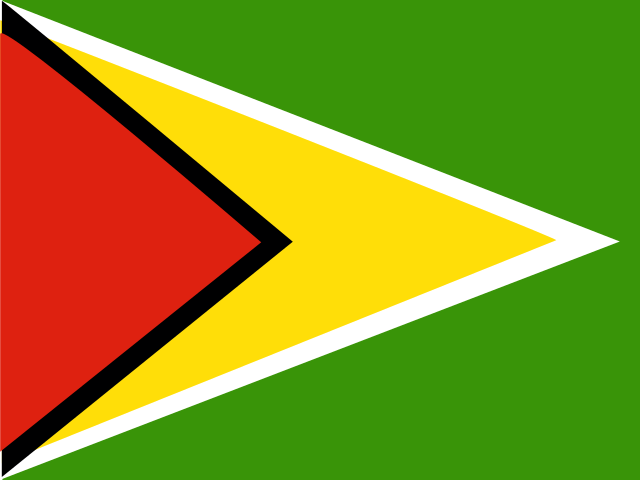
The Guyanese flag, known as the Golden Arrowhead, has a green field with a yellow isosceles triangle based on the hoist side, edged in black. A red triangle with a black border overlays the yellow one, extending toward the fly. A white stripe with a black border runs along the hoist. The proportion is 3:5. It was adopted on 26 May 1966, when Guyana gained independence from Britain.
Colors and meaning
Green represents the agricultural land and forests of Guyana, yellow represents the country's mineral wealth and the golden arrowhead shape that gives the flag its nickname, red represents the zeal and dynamic nature of the Guyanese people and their nation-building, black represents endurance and the country's African heritage, and white represents the rivers and waters of Guyana.
Green
Represents the forests and agricultural land of Guyana. Around 85 percent of the country is covered in forest, and agriculture remains central to its economy.
Yellow
Represents Guyana's mineral wealth, particularly gold, bauxite and diamonds, and the Caribbean sun. The yellow triangle gives the flag its nickname, the Golden Arrowhead.
Red
Represents the zeal, dynamism and enthusiasm of the Guyanese people in building their nation, and the sacrifice required for independence.
Black
Represents endurance and the perseverance of the Guyanese people, and the country's African heritage.
White
Represents the many rivers and waters of Guyana, including the Essequibo, Demerara and Berbice rivers.
Arrowhead shape
The overall design resembles an arrowhead pointing forward, symbolizing Guyana's forward-looking national spirit.
History and adoption
Guyana gained independence from Britain on 26 May 1966, and the Golden Arrowhead flag was adopted on the same day. It was designed by Whitney Smith, an American vexillologist who later became a leading figure in the field. Smith's original design was modified by the British College of Arms, which added black borders to the yellow and white stripes. The design was chosen in an international competition and has remained unchanged since independence. Guyana became a republic within the Commonwealth in 1970, but the flag was retained.
Key facts
- Adopted
- 26 May 1966
- Proportion
- 3:5
- Designer
- Whitney Smith (modified by the College of Arms)
- Capital
- Georgetown
- Country code
- GY
- Similar flags
- None
Historical and related flags
Guyana used several flags during its colonial period before independence, and today uses several official variants.
- Dutch Guiana (pre-1814): Dutch flags used during Dutch colonial rule.
- British Guiana (1814–1875): British Blue Ensign with a colonial badge.
- British Guiana (1875–1954): Blue Ensign with an updated colonial badge.
- British Guiana (1954–1966): Blue Ensign with another revised badge.
- Current flag (1966–present): Golden Arrowhead design adopted at independence.
- Presidential standard: Uses the Guyanese coat of arms on a green field.
Frequently asked questions
What does the flag of Guyana look like?
The flag of Guyana has a green field with a yellow triangle at the hoist edged in black, a red triangle overlaying it, and a white stripe along the hoist. The proportion is 3:5.
When was the flag of Guyana adopted?
The current flag of Guyana was officially adopted on 26 May 1966.
What do the colors mean?
Green represents the agricultural land and forests of Guyana, yellow represents the country's mineral wealth and the golden arrowhead shape that gives the flag its nickname, red represents the zeal and dynamic nature of the Guyanese people and their nation-building, black represents endurance and the country's African heritage, and white represents the rivers and waters of Guyana.
Which flags look similar to the Guyana flag?
No other national flag closely resembles Guyana's. The Golden Arrowhead's unique five-color arrowhead design is unlike any other national flag.

 Suriname
 Venezuela
 Brazil
 Trinidad and Tobago
 Colombia
 South Africa