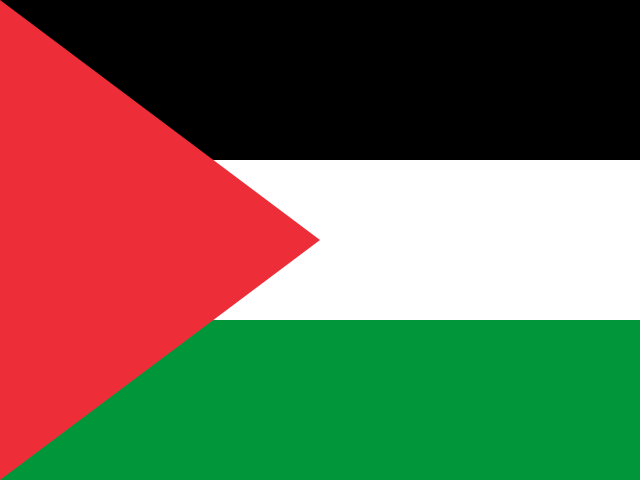
What the flag looks like
The Palestinian flag consists of three horizontal bands of black (top), white (middle) and green (bottom), with a red isosceles triangle at the hoist whose apex extends to the center of the flag. The proportion is 1:2. It was adopted by the Palestine Liberation Organization on 28 May 1964 and became the flag of the State of Palestine when the Palestinian Authority was established in 1994.
Colors and meaning
The black, white and green bands represent the Abbasid, Umayyad and Fatimid caliphates respectively — three of the great Islamic dynasties of Arab history. The red triangle represents the Hashemite dynasty and the blood shed during the Arab Revolt of 1916 and in the Palestinian struggle for self-determination.
Black band
Represents the Abbasid Caliphate (750–1258), which ruled from Baghdad and used black banners as its symbol.
White band
Represents the Umayyad Caliphate (661–750), which ruled from Damascus and used white banners.
Green band
Represents the Fatimid Caliphate (909–1171), which ruled from Cairo and used green banners. Green is also the traditional color of Islam.
Red triangle
Represents the Hashemite dynasty and the blood shed during the Arab Revolt of 1916 and in the Palestinian struggle for self-determination. The red triangle is a common feature of the flags that descend from the Arab Revolt.
Design origin
The flag is based on the flag of the Arab Revolt, designed in 1916 by Sharif Hussein bin Ali and the British diplomat Mark Sykes. The Sharifian flag used the same black, white and green bands with a red triangle. It was adopted by the Palestine Liberation Organization on 28 May 1964 as the flag of the Palestinian people.
History and adoption
The Palestinian flag is based on the flag of the Arab Revolt of 1916, which was used by Arab nationalist forces against the Ottoman Empire during World War I. The flag of the Arab Revolt was designed by Sharif Hussein bin Ali of Mecca, with the colors representing the great Islamic dynasties of Arab history. After World War I, the flag was used in various forms by Arab nationalist movements in the region. The Palestine Liberation Organization formally adopted the design as the flag of Palestine on 28 May 1964, at the first Palestinian National Council meeting in Jerusalem. In 1988, the Palestinian Declaration of Independence reaffirmed the flag's status. It has been the flag of the Palestinian Authority since 1994 and remains the flag of the State of Palestine, which is recognized by a majority of UN member states.
Key facts
- Adopted
- 28 May 1964
- Proportion
- 1:2
- Designer
- Based on the flag of the Arab Revolt (1916)
- Capital
- Ramallah (administrative), East Jerusalem (claimed)
- Country code
- PS
- Similar flags
- Jordan, Kuwait, UAE
Historical and related flags
The Palestinian flag has been used in various forms across the region's modern history.
- Arab Revolt flag (1916–1920): Black, white and green bands with a red triangle.
- All-Palestine Government (1948–1959): Same design used briefly.
- PLO flag (1964–present): Formal adoption by the Palestine Liberation Organization.
- State of Palestine (1988–present): Reaffirmed by the Palestinian Declaration of Independence.
- Palestinian Authority (1994–present): Official flag of the Palestinian Authority.
Frequently asked questions
What does the flag of Palestine look like?
The flag of Palestine has three horizontal bands of black (top), white (middle) and green (bottom), with a red isosceles triangle at the hoist. The proportion is 1:2.
When was the flag of Palestine adopted?
The current flag of Palestine was officially adopted on 28 May 1964.
What do the colors mean?
The black, white and green bands represent the Abbasid, Umayyad and Fatimid caliphates respectively — three of the great Islamic dynasties of Arab history. The red triangle represents the Hashemite dynasty and the blood shed during the Arab Revolt of 1916 and in the Palestinian struggle for self-determination.
Which flags look similar to the Palestine flag?
Jordan uses the same black-white-green bands with a red triangle, but with a white seven-pointed star inside the triangle. Kuwait uses green-white-red with a black trapezoid. The UAE uses a red hoist band with green-white-black bands. Palestine's flag is distinguished by its plain red triangle without a star.

 Jordan
 Kuwait
 United Arab Emirates
 Saudi Arabia
 Iraq
 Syria