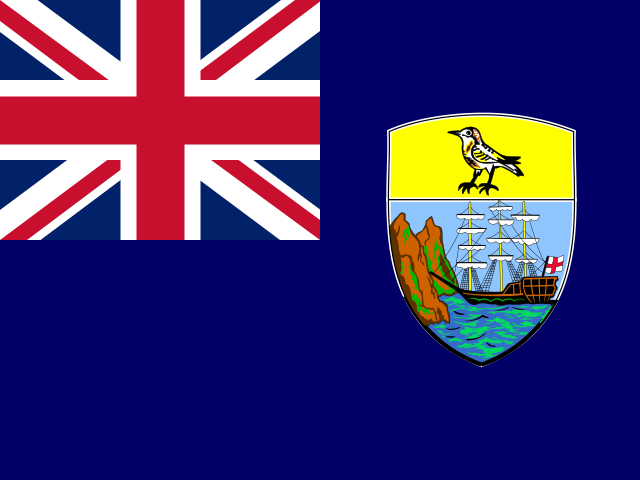
What the flag looks like
The Tristan da Cunha flag consists of a blue field with the Union Jack in the upper hoist canton and the Tristan da Cunha shield in the fly half. The shield features a longboat — the traditional wooden boat used by islanders to travel between the islands of the group — above a Tristan rock lobster and a volcano. The proportion is 1:2. It was adopted on 20 October 2002, when Tristan da Cunha was granted its own flag as part of the British Overseas Territory of Saint Helena, Ascension and Tristan da Cunha.
Colors and meaning
The blue field and Union Jack represent Tristan da Cunha's status as part of a British Overseas Territory and its connection to the United Kingdom, the blue also representing the South Atlantic Ocean that surrounds the islands. The shield represents the islanders' traditional way of life — the longboat, the rock lobster fishery and the volcanic landscape of the island group.
Union Jack
Represents Tristan da Cunha's constitutional status as part of the British Overseas Territory of Saint Helena, Ascension and Tristan da Cunha. The Union Jack appears in the upper hoist canton of the flag, following the standard pattern for British colonial and overseas territory flags.
Blue field
Represents the South Atlantic Ocean that surrounds Tristan da Cunha — the most remote inhabited archipelago in the world, located about 2,400 kilometers west of Saint Helena and 2,800 kilometers from the coast of South Africa.
Longboat
The traditional wooden boat used by Tristan islanders to travel between the islands of the group and to reach passing ships. Longboats are hand-built on the island and are central to Tristan's seafaring culture. Because the islands have no harbor, longboats are the only way to reach the shore.
Tristan rock lobster
Known locally as the 'Tristan crayfish', the rock lobster is the island's main export and the backbone of its economy. The lobster fishery has been operating since the 1950s and is a sustainable, community-run industry.
Volcano
Represents the volcanic origin of the Tristan da Cunha archipelago. The island of Tristan da Cunha itself is a volcano — Queen Mary's Peak, the summit of the island, rises to 2,062 meters and is the highest point in the South Atlantic. A 1961 eruption forced the entire population to evacuate to England for two years before they returned.
History and adoption
Tristan da Cunha was discovered by the Portuguese navigator Tristão da Cunha in 1506 and was annexed by Britain in 1816. It was administered as a dependency of Saint Helena from 1938 and became part of the British Overseas Territory of Saint Helena, Ascension and Tristan da Cunha in 2009 under a new constitution. Tristan da Cunha's flag was adopted on 20 October 2002, when the island was granted its own Blue Ensign with its own shield in the fly. The flag was retained after the 2009 constitutional reorganization. It is used locally on the island, alongside the Union Jack (which is used for the territory as a whole) and the Saint Helena flag.
Key facts
- Adopted
- 20 October 2002
- Proportion
- 1:2
- Designer
- Based on the Tristan da Cunha coat of arms granted in 2002
- Capital
- Edinburgh of the Seven Seas
- Country code
- SH-TA
- Similar flags
- Other British Overseas Territories
Historical and related flags
Tristan da Cunha has used several flags across its history, and related flags exist for the wider territory.
- British dependency (1816–1938): British Union Jack and colonial flags used.
- Dependency of Saint Helena (1938–2009): Saint Helena flag used.
- Current flag (2002–present): Blue Ensign with the Tristan da Cunha shield.
- Union Jack: Used for the territory as a whole, alongside the three island flags.
- Flag of Saint Helena, Ascension and Tristan da Cunha: No single combined flag exists; the Union Jack serves that purpose.
- Administrator's flag: A Union Jack defaced with the Tristan da Cunha coat of arms in the center.
Frequently asked questions
What does the flag of Tristan da Cunha look like?
The flag of Tristan da Cunha is a British Blue Ensign — a blue field with the Union Jack in the upper hoist canton and the Tristan da Cunha shield in the fly. The proportion is 1:2.
When was the flag of Tristan da Cunha adopted?
The current flag of Tristan da Cunha was officially adopted on 20 October 2002.
What do the colors mean?
The blue field and Union Jack represent Tristan da Cunha's status as part of a British Overseas Territory and its connection to the United Kingdom, the blue also representing the South Atlantic Ocean that surrounds the islands. The shield represents the islanders' traditional way of life — the longboat, the rock lobster fishery and the volcanic landscape of the island group.
Which flags look similar to the Tristan da Cunha flag?
Tristan da Cunha's flag follows the standard pattern for British Overseas Territories — a Blue Ensign with the Union Jack in the canton and a distinctive shield in the fly. It is similar in structure to the flags of Saint Helena, Ascension Island, the Falkland Islands and Montserrat, but its shield with the longboat, rock lobster and volcano is unique.

 United Kingdom
 Saint Helena
 Ascension Island
 Falkland Islands
 Montserrat
 South Africa