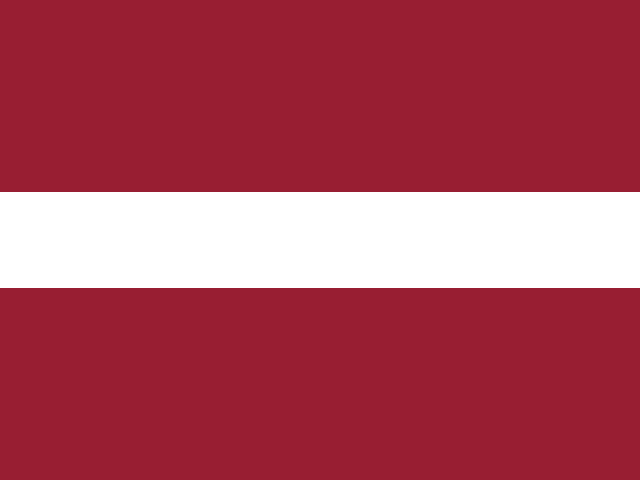
What the flag looks like
The Latvian flag consists of a dark red (carmine) field divided by a narrow white horizontal stripe. The red bands are twice as wide as the white stripe. The proportion is 1:2. It was readopted on 27 February 1990, shortly before Latvia declared independence from the Soviet Union, though the design dates back to the 13th century.
Colors and meaning
The dark red represents the blood shed for Latvian independence and the courage of the Latvian people. According to legend, the color originates from a wounded Latvian chief wrapped in a white sheet — his blood stained the cloth, leaving only the strip where his body lay unstained. White represents peace, purity and hope.
Carmine red
Represents the blood shed for Latvian independence and the courage of the Latvian people. The shade is officially 'Latvian red' (Latvijas sarkanais) and is a dark carmine, distinct from standard reds.
White
Represents peace, purity and hope, and the strip of unstained cloth from the flag's origin legend.
Legend of the wounded chief
According to a 13th-century chronicle, a Latvian chief was wounded in battle and wrapped in a white sheet. His blood stained the cloth except for the strip where his body lay, creating the red-white-red pattern. The chief is said to have used this cloth as a banner in his next battle, where he was victorious.
Historical origin
The earliest written mention of a red-and-white Latvian flag comes from the Livonian Rhymed Chronicle, written around 1290.
History and adoption
The Latvian flag is one of the oldest flag designs in the world, with the first written mention in the Livonian Rhymed Chronicle around 1290. The design was used by Latvian tribes in the medieval period but was forgotten under foreign rule. It was rediscovered during the Latvian national revival in the 19th century and adopted by the Latvian Students' Union in 1870. When Latvia declared independence on 18 November 1918, the red-white-red flag was adopted on 15 June 1921. During the Soviet occupation (1940–1991), the flag was banned. It was readopted on 27 February 1990 and confirmed by the Latvian constitution after independence was restored in 1991.
Key facts
- Adopted
- 27 February 1990
- Proportion
- 1:2
- Designer
- Traditional — mentioned in the Livonian Rhymed Chronicle (c. 1290)
- Capital
- Riga
- Country code
- LV
- Similar flags
- Austria
Historical and related flags
Latvia has used several flags across its medieval, independence, Soviet and post-Soviet periods.
- Medieval Latvian tribes (13th century): Red-and-white banners first mentioned in chronicles.
- First Republic (1921–1940): Red-white-red flag formally adopted.
- Latvian SSR (1940–1953): Soviet red flag with hammer and sickle.
- Latvian SSR (1953–1990): Red flag with blue-white-red stripes at the bottom.
- Current flag (1990–present): Red-white-red flag readopted.
- Presidential standard: Uses the Latvian coat of arms on a red field.
Frequently asked questions
What does the flag of Latvia look like?
The flag of Latvia has a dark red (carmine) field with a narrow white horizontal stripe through the middle. The proportion is 1:2.
When was the flag of Latvia adopted?
The current flag of Latvia was officially adopted on 27 February 1990.
What do the colors mean?
The dark red represents the blood shed for Latvian independence and the courage of the Latvian people. According to legend, the color originates from a wounded Latvian chief wrapped in a white sheet — his blood stained the cloth, leaving only the strip where his body lay unstained. White represents peace, purity and hope.
Which flags look similar to the Latvia flag?
Austria uses a red-white-red horizontal tricolor with equal-width bands. Latvia's red bands are twice as wide as the white stripe and use a darker carmine shade, making it visually distinct.

 Estonia
 Lithuania
 Austria
 Finland
 Sweden
 Belarus