What the flag looks like
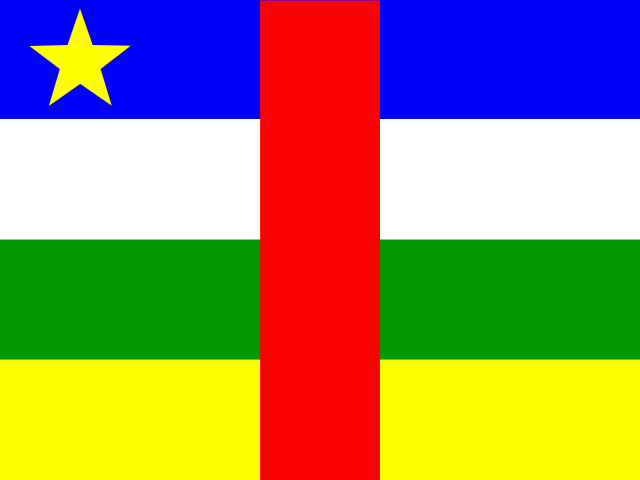
The flag of the Central African Republic consists of four horizontal bands of blue (top), white, green and yellow (bottom), crossed by a vertical red stripe through the center. A yellow five-pointed star appears in the upper hoist corner, on the blue band. The proportion is 3:5. It was adopted on 1 December 1958, when the country became an autonomous republic within the French Community, two years before full independence.
Colors and meaning
The four horizontal bands combine the colors of the French Tricolore (blue, white and red) with the Pan-African colors (green and yellow). Blue, white and red represent France and the country's colonial heritage, green represents hope and faith, yellow represents the savanna and prosperity, and the yellow star represents the bright future of the Central African people and their unity.
Blue, white and red
These three colors are taken from the French Tricolore, reflecting the Central African Republic's historical ties to France. Blue represents liberty, white represents equality, and red represents brotherhood — the French national motto.
Green
Represents hope and faith in the future, and the country's forests, which are among the densest in Africa.
Yellow
Represents the savanna and the country's mineral wealth. Yellow also represents the sun, which shines year-round in this equatorial country.
Red vertical stripe
Represents the blood that unites all Central Africans and the blood shed for independence — a common thread running through the country's population.
Yellow star
Represents the bright future of the Central African people and their unity under one flag. It is also a symbol of African emancipation, drawing on the symbolism of the star on Ghana's flag.
History and adoption
The Central African Republic was a French colony known as Ubangi-Shari from 1903 until 1958, when it became an autonomous republic within the French Community. The flag was designed by Barthélémy Boganda, the country's first prime minister and a leading independence figure, who wanted to symbolize both the country's French colonial heritage and its African identity. It was adopted on 1 December 1958, and was retained when the country gained full independence on 13 August 1960. The flag has remained unchanged since, including through the rule of Emperor Bokassa I (who used a personal imperial standard) and the many political upheavals the country has faced since.
Key facts
- Adopted
- 1 December 1958
- Proportion
- 3:5
- Designer
- Barthélémy Boganda
- Capital
- Bangui
- Country code
- CF
- Similar flags
- None
Historical and related flags
The Central African Republic has used the same flag since 1958, with only one brief imperial variation.
- French Ubangi-Shari (1903–1958): French flag used during colonial rule.
- Autonomous republic (1958–1960): Current flag adopted.
- Central African Empire (1976–1979): Imperial standard used by Emperor Bokassa I, alongside the national flag.
- Current flag (1960–present): Same design throughout, including after the republic was restored in 1979.
- Presidential standard: Uses the Central African coat of arms on a red field.
Frequently asked questions
What does the flag of Central African Republic look like?
The flag of the Central African Republic has four horizontal bands of blue, white, green and yellow, crossed by a vertical red stripe, with a yellow five-pointed star in the upper hoist corner. The proportion is 3:5.
When was the flag of Central African Republic adopted?
The current flag of Central African Republic was officially adopted on 1 December 1958.
What do the colors mean?
The four horizontal bands combine the colors of the French Tricolore (blue, white and red) with the Pan-African colors (green and yellow). Blue, white and red represent France and the country's colonial heritage, green represents hope and faith, yellow represents the savanna and prosperity, and the yellow star represents the bright future of the Central African people and their unity.
Which flags look similar to the Central African Republic flag?
No other national flag closely resembles the Central African Republic's. The combination of four horizontal bands with a vertical red stripe and a yellow star is unique.

 Cameroon
 Chad
 Republic of the Congo
 DR Congo
 Sudan
 South Sudan