What the flag looks like
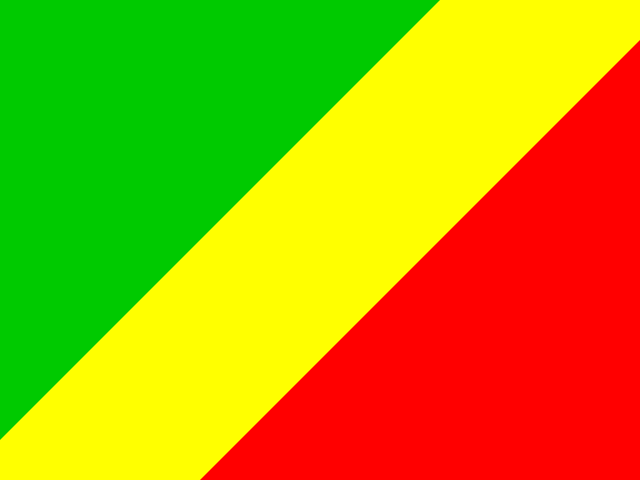
The flag of the Republic of the Congo is divided diagonally from the lower hoist corner to the upper fly corner by a yellow band. The upper triangle is green and the lower triangle is red. The proportion is 2:3. It was originally adopted on 15 August 1959, replaced during the Marxist-Leninist period from 1970 to 1991, and readopted on 10 June 1991.
Colors and meaning
Green represents the forests and natural wealth of the Congo, yellow represents the country's mineral resources and the friendship and nobility of its people, and red represents the blood shed for Congolese independence and the unity of the nation. The diagonal arrangement gives the flag its distinctive look.
Green
Represents the forests, agriculture and natural wealth of the Republic of the Congo. The country is named after the Congo River, which flows through the world's second-largest rainforest.
Yellow
Represents the country's mineral wealth, its bright future and the friendship and nobility of the Congolese people. Yellow is the diagonal band, splitting the green and red.
Red
Represents the blood shed by Congolese patriots in the struggle for independence and the unity of the diverse peoples of the Republic of the Congo.
Pan-African colors
The green, yellow and red are the Pan-African colors, adopted by many newly independent African states as a symbol of African unity and independence.
Design distinction
The flag is often confused with that of DR Congo, but the two are distinct: the Republic of the Congo's flag is a diagonal green-yellow-red, while DR Congo's is a blue field with a diagonal red-yellow stripe and a yellow star.
History and adoption
The Republic of the Congo was a French colony from 1880 until 1960, when it gained independence on 15 August 1960. The green-yellow-red diagonal flag was designed in 1958 and first raised on 15 August 1959, one year before independence. In 1970, the country became the People's Republic of the Congo under a Marxist-Leninist government, and a new red flag with a hammer and sickle, a palm frond and a gold star was adopted. After the fall of the socialist government in 1991, the original 1959 flag was readopted on 10 June 1991 and has remained unchanged since.
Key facts
- Adopted
- 10 June 1991
- Proportion
- 2:3
- Designer
- Based on the Pan-African colors
- Capital
- Brazzaville
- Country code
- CG
- Similar flags
- DR Congo
Historical and related flags
The Republic of the Congo has used two main flags across its post-independence history.
- French Congo (1880–1960): French flag used during colonial rule.
- First flag (1959–1970): Green-yellow-red diagonal design.
- People's Republic of the Congo (1970–1991): Red flag with hammer and sickle, palm frond and gold star.
- Current flag (1991–present): Original 1959 design readopted.
- Presidential standard: Uses the Congolese coat of arms.
Frequently asked questions
What does the flag of Republic of the Congo look like?
The flag of the Republic of the Congo is divided diagonally by a yellow band, with green in the upper hoist triangle and red in the lower fly triangle. The proportion is 2:3.
When was the flag of Republic of the Congo adopted?
The current flag of Republic of the Congo was officially adopted on 10 June 1991.
What do the colors mean?
Green represents the forests and natural wealth of the Congo, yellow represents the country's mineral resources and the friendship and nobility of its people, and red represents the blood shed for Congolese independence and the unity of the nation. The diagonal arrangement gives the flag its distinctive look.
Which flags look similar to the Republic of the Congo flag?
DR Congo uses a similar diagonal design but with a sky-blue field, a red-yellow stripe, and a yellow star in the upper hoist. The Republic of the Congo's green-yellow-red diagonal is visually distinct once you look at the colors.

 DR Congo
 Gabon
 Central African Republic
 Cameroon
 Angola
 Senegal