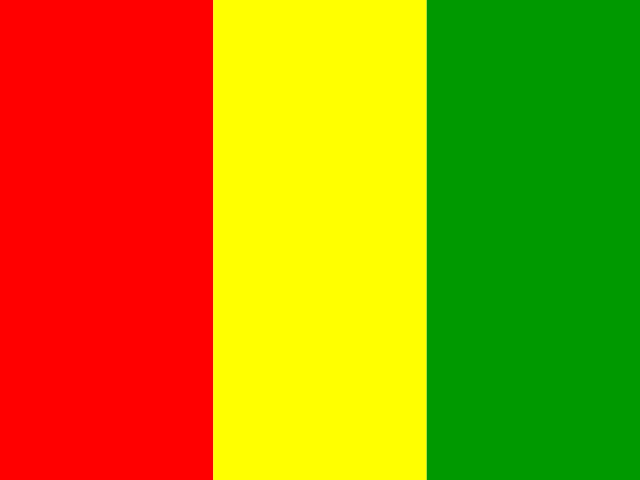
What the flag looks like
The Guinean flag consists of three equal vertical bands of red (hoist), yellow (center) and green (fly). The proportion is 2:3. It was adopted on 10 November 1958, when Guinea became the first French African colony to gain independence by rejecting the French Community in a referendum.
Colors and meaning
Red represents the blood shed in the struggle for independence and the sacrifice of the Guinean people, yellow represents the sun and the country's mineral wealth — Guinea holds the world's largest reserves of bauxite — and green represents the vegetation and agricultural wealth of the country. The colors are the Pan-African colors, adopted by many newly independent African states.
Red
Represents the blood shed by Guinean patriots during the struggle for independence from France, achieved in 1958 when Guinea voted 'No' to the French Community in a historic referendum led by Ahmed Sékou Touré.
Yellow
Represents the sun and Guinea's mineral wealth. Guinea holds the world's largest reserves of bauxite and significant deposits of iron ore, gold and diamonds.
Green
Represents the vegetation and agricultural wealth of Guinea. The country has diverse landscapes, from coastal mangroves to highland forests and savanna.
Pan-African colors
The red, yellow and green are the Pan-African colors, first used by Ethiopia and later adopted by Ghana, Guinea and many other newly independent African states as a symbol of African unity and independence.
Design origin
The flag was designed in 1958 and adopted on 10 November 1958. It combines the Pan-African colors with the vertical layout of the French Tricolore, reflecting Guinea's break from France while acknowledging the country's Francophone heritage.
History and adoption
Guinea was a French colony from 1890 until 1958, when it became the first French African colony to reject the French Community in a referendum on 28 September 1958, choosing immediate independence instead. Under the leadership of Ahmed Sékou Touré, Guinea declared independence on 2 October 1958, and the flag was adopted on 10 November 1958. The design was created to be distinct from the French Tricolore while retaining a similar layout, using the Pan-African colors that were becoming the symbol of African independence. The flag has remained unchanged since, despite decades of political changes including the death of Sékou Touré in 1984 and the subsequent military coups.
Key facts
- Adopted
- 10 November 1958
- Proportion
- 2:3
- Designer
- Based on the Pan-African colors and French Tricolore
- Capital
- Conakry
- Country code
- GN
- Similar flags
- Mali, Senegal, Rwanda
Historical and related flags
Guinea used several flags during its colonial period before independence.
- French Guinea (1890–1958): French flag used during colonial rule.
- Current flag (1958–present): Red-yellow-green vertical bands adopted at independence.
- Presidential standard: Uses the Guinean coat of arms with a dove and an elephant.
Frequently asked questions
What does the flag of Guinea look like?
The flag of Guinea has three equal vertical bands of red (hoist), yellow (center) and green (fly). The proportion is 2:3.
When was the flag of Guinea adopted?
The current flag of Guinea was officially adopted on 10 November 1958.
What do the colors mean?
Red represents the blood shed in the struggle for independence and the sacrifice of the Guinean people, yellow represents the sun and the country's mineral wealth — Guinea holds the world's largest reserves of bauxite — and green represents the vegetation and agricultural wealth of the country. The colors are the Pan-African colors, adopted by many newly independent African states.
Which flags look similar to the Guinea flag?
Mali uses green-yellow-red — the reverse of Guinea. Senegal uses green-yellow-red with a green star in the center. Rwanda uses blue-yellow-green with a sun. Guinea's plain red-yellow-green vertical bands are unique.

 Mali
 Senegal
 Sierra Leone
 Liberia
 Ivory Coast
 Guinea-Bissau