What the flag looks like
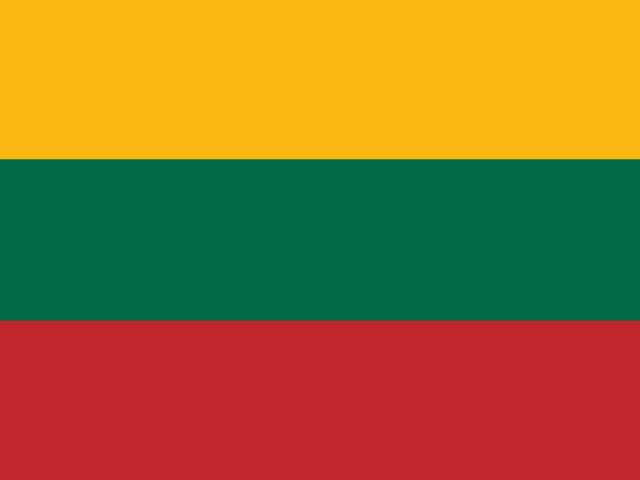
The Lithuanian flag consists of three equal horizontal bands of yellow (top), green (middle) and red (bottom). The proportion is 3:5. It was readopted on 20 March 1989, shortly before Lithuania declared independence from the Soviet Union, and has remained unchanged since. The colors were first used by Lithuanian nationalists in the late 19th century.
Colors and meaning
Yellow represents the sun, light and prosperity, green represents the fields, forests and hope of the Lithuanian people, and red represents the earth, courage and the blood shed for Lithuanian independence. The colors are derived from Lithuanian folk weaving traditions and were formally adopted in 1918.
Yellow
Represents the sun, light, prosperity and the golden fields of grain that have long been central to Lithuanian agriculture.
Green
Represents the forests, fields and hope of the Lithuanian people. Lithuania has some of the oldest forests in Europe and green is associated with nature and vitality.
Red
Represents the earth, courage and the blood shed for Lithuanian independence. It is the bottom band, grounding the flag in the soil and the sacrifices of the nation.
Origin
The colors were proposed by Lithuanian national revival activists in the late 19th century, drawing on traditional Lithuanian folk textiles and the colors of the Lithuanian landscape.
History and adoption
The yellow-green-red tricolor was first proposed by Lithuanian national revival activists in the late 19th century. It was adopted as the flag of the short-lived Lithuanian Soviet Socialist Republic in 1918–1919, then adopted by the independent Republic of Lithuania on 19 April 1918. It was used until 1940, when the Soviet Union annexed Lithuania. During the Soviet occupation (1940–1989), the flag was banned and replaced with the flag of the Lithuanian SSR. The tricolor was readopted on 20 March 1989, before Lithuania declared independence on 11 March 1990. The proportions and shades were standardized in 1991.
Key facts
- Adopted
- 20 March 1989
- Proportion
- 3:5
- Designer
- Jonas Basanavičius, Antanas Žmuidzinavičius, Tadas Daugirdas
- Capital
- Vilnius
- Country code
- LT
- Similar flags
- Myanmar, Bolivia
Historical and related flags
Lithuania has used several flags across its medieval, independence, Soviet and post-Soviet periods.
- Grand Duchy of Lithuania (14th–18th century): The Vytis — a white knight on horseback on a red field.
- Lithuanian SSR (1918–1919): Red flag used briefly.
- First Republic (1918–1940): Yellow-green-red tricolor adopted.
- Lithuanian SSR (1940–1953): Soviet red flag with hammer and sickle.
- Lithuanian SSR (1953–1989): Red flag with green-white stripes at the bottom.
- Current flag (1989–present): Yellow-green-red tricolor restored.
- State flag: Adds the historical Vytis coat of arms on the middle band.
Frequently asked questions
What does the flag of Lithuania look like?
The flag of Lithuania has three equal horizontal bands of yellow (top), green (middle) and red (bottom). The proportion is 3:5.
When was the flag of Lithuania adopted?
The current flag of Lithuania was officially adopted on 20 March 1989.
What do the colors mean?
Yellow represents the sun, light and prosperity, green represents the fields, forests and hope of the Lithuanian people, and red represents the earth, courage and the blood shed for Lithuanian independence. The colors are derived from Lithuanian folk weaving traditions and were formally adopted in 1918.
Which flags look similar to the Lithuania flag?
Myanmar uses yellow-green-red with a white star in the center. Bolivia uses red-yellow-green — a different order. Lithuania's plain yellow-green-red is unique among national flags.

 Latvia
 Estonia
 Poland
 Belarus
 Ukraine
 Russia