What the flag looks like
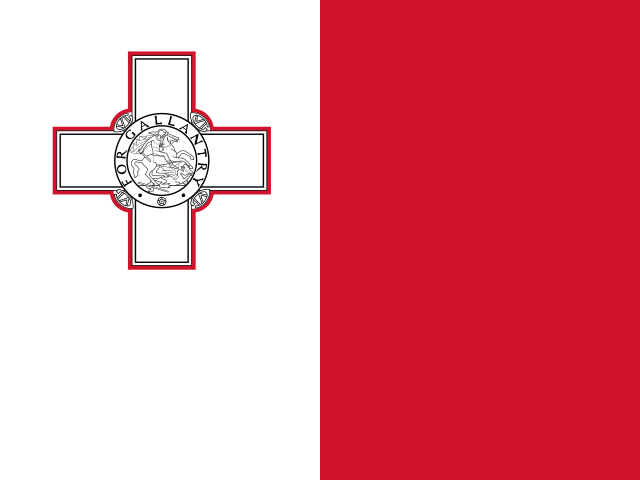
The Maltese flag consists of two equal vertical bands of white (hoist) and red (fly). In the upper hoist corner of the white band is the George Cross — a silver cross with the inscription 'For Gallantry' on a blue background. The proportion is 2:3. The flag was adopted on 21 September 1964, when Malta gained independence from Britain, and was retained when Malta became a republic in 1974.
Colors and meaning
White represents peace, purity and the light of the Mediterranean, and red represents the blood shed for Maltese independence and the courage of the Maltese people. According to tradition, the colors date back to the time of Roger I of Sicily, who gave them to the Maltese in 1091. The George Cross represents Malta's bravery during World War II.
White band
Represents peace, purity and the light of the Mediterranean. White was traditionally associated with the Maltese people's peaceful character and their historic Christian faith.
Red band
Represents the blood shed by Maltese patriots in defense of their island and the courage of the Maltese people. Red is also a traditional color of Mediterranean and Mediterranean island flags.
George Cross
Represents Malta's bravery during World War II, when the island was heavily bombed by Italian and German forces from 1940 to 1942. King George VI awarded the George Cross — the highest civilian award for gallantry in the United Kingdom — to the island of Malta on 15 April 1942, in recognition of the population's endurance. The medal appears on the flag as a silver cross with a blue border, inscribed with the words 'For Gallantry'.
History and adoption
Malta was a British colony from 1814 until 1964, when it gained independence on 21 September 1964. The white-and-red flag has been associated with the Maltese islands since at least the 13th century, when tradition says it was given to the Maltese by Roger I of Sicily in 1091. During the British colonial period, the flag was used with the Maltese coat of arms in the canton of a blue ensign. When Malta gained independence in 1964, the plain white-and-red design was adopted as the national flag, with the George Cross added to the upper hoist corner. The George Cross had been awarded to Malta in 1942, and its inclusion on the flag reflects the country's wartime experience. The flag was retained when Malta became a republic in 1974. It has remained unchanged since.
Key facts
- Adopted
- 21 September 1964
- Proportion
- 2:3
- Designer
- Based on the traditional Maltese white-and-red flag, with the George Cross added in 1943
- Capital
- Valletta
- Country code
- MT
- Similar flags
- None
Historical and related flags
Malta has used several flags across its Hospitaller, French, British and independence periods.
- Knights Hospitaller (1530–1798): Red flag with a white eight-pointed cross (the Maltese Cross).
- French occupation (1798–1800): French tricolor used.
- British Malta (1800–1964): British Blue Ensign with the Maltese coat of arms.
- Self-government (1943–1964): White-red flag with the George Cross in the canton.
- Current flag (1964–present): White and red vertical bands with the George Cross.
- Presidential standard: Uses the Maltese coat of arms on a blue field.
Frequently asked questions
What does the flag of Malta look like?
The flag of Malta has two equal vertical bands of white (hoist) and red (fly), with the George Cross — a silver cross on a blue background — in the upper hoist corner of the white band. The proportion is 2:3.
When was the flag of Malta adopted?
The current flag of Malta was officially adopted on 21 September 1964.
What do the colors mean?
White represents peace, purity and the light of the Mediterranean, and red represents the blood shed for Maltese independence and the courage of the Maltese people. According to tradition, the colors date back to the time of Roger I of Sicily, who gave them to the Maltese in 1091. The George Cross represents Malta's bravery during World War II.
Which flags look similar to the Malta flag?
No other national flag closely resembles Malta's. The combination of white and red vertical bands with the George Cross in the canton is unique.

 Italy
 Greece
 Cyprus
 Tunisia
 Libya
 United Kingdom