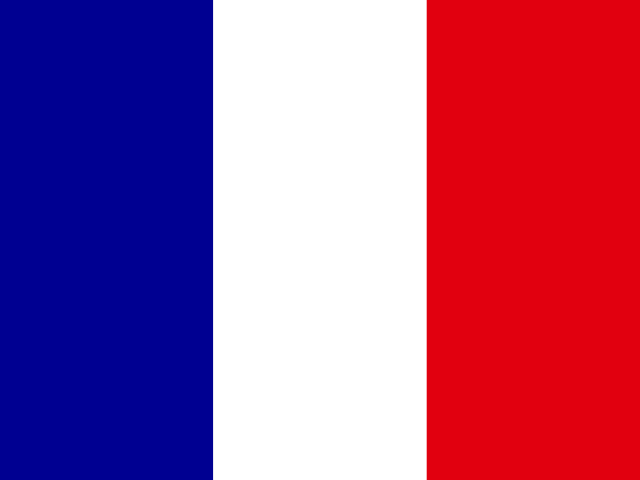
What the flag looks like
The French flag consists of three equal vertical bands of blue (hoist), white (center) and red (fly). The proportion is 2:3. It was adopted on 15 February 1794 during the French Revolution and has remained the national flag ever since, with only brief interruptions in 1814–1830 and 1848.
Colors and meaning
Blue and red are the traditional colors of Paris, worn by the militia that stormed the Bastille in 1789. White was the color of the Bourbon monarchy. Combined, they represent the union of the people and the crown under the new republic — and are popularly said to stand for liberty, equality and fraternity.
Blue
The traditional color of Paris, associated with Saint Martin and the city's militia. Often linked to liberty.
White
The color of the Bourbon monarchy and the royal standard of France before the Revolution. Placed between blue and red, it represents peace and the reconciliation of the nation.
Red
The traditional color of Paris, associated with Saint Denis and the revolutionary flag of 1789. Often linked to equality and the blood of the revolution.
Liberty, Equality, Fraternity
The popular association of blue, white and red with the national motto is a 19th-century interpretation, not part of the original design.
History and adoption
The Tricolore emerged during the French Revolution. On 13 July 1789, the day before the storming of the Bastille, Parisian militia adopted a cockade of blue and red — the city's colors. On 17 July, Lafayette added white to create a national cockade combining the colors of Paris with the royal white. A flag based on this cockade was adopted by the National Convention on 15 February 1794. It was briefly replaced during the Bourbon Restoration (1814–1830) and the Second Republic (1848), but has been the national flag continuously since 1830.
Key facts
- Adopted
- 15 February 1794
- Proportion
- 2:3
- Designer
- Lafayette (cockade origin)
- Capital
- Paris
- Country code
- FR
- Similar flags
- Netherlands, Russia, Luxembourg
Historical and related flags
France has changed its national flag several times, and the Tricolore itself has been used in several configurations.
- Kingdom of France (pre-1789): White flag with golden fleurs-de-lis.
- Bourbon Restoration (1814–1830): Plain white flag.
- July Monarchy (1830–1848): Tricolore with a restored cockade.
- Second Republic (1848): Briefly red flag considered, then Tricolore retained.
- Vichy France (1940–1944): Tricolore with a Francisque emblem.
- Free France (1940–1944): Tricolore with a red Cross of Lorraine.
Frequently asked questions
What does the flag of France look like?
The flag of France is a vertical tricolor of blue, white and red in three equal bands. It is known as the Tricolore.
When was the flag of France adopted?
The current flag of France was officially adopted on 15 February 1794.
What do the colors mean?
Blue and red are the traditional colors of Paris, worn by the militia that stormed the Bastille in 1789. White was the color of the Bourbon monarchy. Combined, they represent the union of the people and the crown under the new republic — and are popularly said to stand for liberty, equality and fraternity.
Which flags look similar to the France flag?
The Netherlands and Luxembourg also use vertical blue-white-red tricolors, but with different proportions and shades. France's blue is darker and Luxembourg's blue is lighter.

 Italy
 Netherlands
 Belgium
 Ireland
 Russia
 Luxembourg