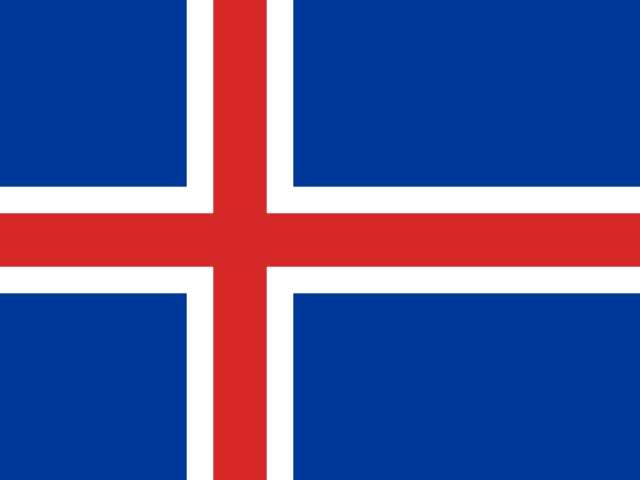
What the flag looks like
The Icelandic flag consists of a blue field bearing a red Nordic cross with a white border. The vertical bar of the cross is offset toward the hoist. The proportion is 18:25 for the national flag, with a swallow-tailed version for the military. It was adopted on 17 June 1944, when Iceland became a republic, though a similar design had been used since 1915.
Colors and meaning
Blue represents the Atlantic Ocean surrounding Iceland, white represents the snow and ice of the glaciers, and red represents the volcanic fire and lava that shape the island. Together they evoke Iceland's landscape of ice and fire.
Blue
Represents the Atlantic Ocean, which surrounds Iceland on all sides, and the country's maritime heritage.
White
Represents the snow and ice that cover Iceland's glaciers and highlands, and the purity of the Icelandic landscape.
Red
Represents the volcanic fire and lava that created the island and continue to shape it today. Iceland sits on the Mid-Atlantic Ridge and has over 30 active volcanic systems.
Nordic cross
The cross design is shared with Denmark, Sweden, Norway and Finland, representing Christianity and Nordic unity. Iceland adopted it to emphasize its Scandinavian cultural heritage.
History and adoption
The first Icelandic flag was proposed in 1913 by Matthías Þórðarson and approved in 1915 for use on ships. It was a blue field with a red cross bordered in white, but the design was slightly different from the current one. When Iceland became a sovereign state in personal union with Denmark in 1918, the flag was adopted as the national flag. On 17 June 1944, when Iceland became a fully independent republic, the current proportions were formally adopted. The date is now celebrated as Icelandic National Day.
Key facts
- Adopted
- 17 June 1944
- Proportion
- 18:25
- Designer
- Matthías Þórðarson
- Capital
- Reykjavík
- Country code
- IS
- Similar flags
- Norway, Denmark, Sweden, Finland
Historical and related flags
Iceland has used several flag designs before adopting the current one in 1944.
- Danish rule (pre-1915): The Danish Dannebrog used as the official flag.
- First Icelandic flag (1915–1918): Blue field with a red-and-white cross, slightly different proportions.
- Kingdom of Iceland (1918–1944): Same design used under the personal union with Denmark.
- Republic of Iceland (1944–present): Current design with standardized proportions.
- State flag: Swallow-tailed version used on government buildings.
- Naval ensign: Swallow-tailed version used by the Icelandic Coast Guard.
Frequently asked questions
What does the flag of Iceland look like?
The flag of Iceland is a blue field with a red Nordic cross bordered in white. The proportion is 18:25.
When was the flag of Iceland adopted?
The current flag of Iceland was officially adopted on 17 June 1944.
What do the colors mean?
Blue represents the Atlantic Ocean surrounding Iceland, white represents the snow and ice of the glaciers, and red represents the volcanic fire and lava that shape the island. Together they evoke Iceland's landscape of ice and fire.
Which flags look similar to the Iceland flag?
Norway uses a red field with a blue cross bordered in white — essentially the reverse of Iceland's. Denmark uses red with a plain white cross, Sweden uses blue with a yellow cross, and Finland uses white with a blue cross. Iceland's blue field with a red-and-white cross is unique.

 Norway
 Denmark
 Sweden
 Finland
 Greenland
 Ireland