What the flag looks like
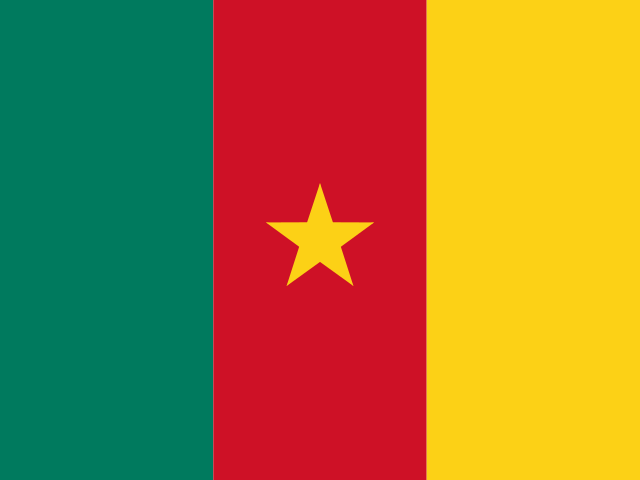
The Cameroonian flag consists of three equal vertical bands of green (hoist), red (center) and yellow (fly), with a yellow five-pointed star centered on the red band. The proportion is 2:3. It was adopted on 20 May 1975, following the country's transition from a federal to a unitary state, and has remained unchanged since.
Colors and meaning
Green represents the forests of southern Cameroon and hope for the future, red represents the blood shed for Cameroonian independence and the unity of the nation, and yellow represents the savannas of northern Cameroon and the sun. The yellow star represents the unity of the Cameroonian people.
Green
Represents the dense forests of southern Cameroon and hope for the future. Cameroon has some of the most biodiverse forests in Africa.
Red
Represents the blood shed by Cameroonian patriots in the struggle for independence and reunification, and the unity of the nation. Red is also the color of the Pan-African movement.
Yellow
Represents the savannas of northern Cameroon, the sun and the country's mineral wealth. Yellow is also a traditional color of African unity movements.
Yellow star
Represents the unity of the Cameroonian people and the country's aspiration for progress. The five points of the star represent the five major regions of Cameroon at the time of independence.
Design origin
The design was inspired by the French Tricolore and the Pan-African colors adopted by many newly independent African nations. The first version, adopted in 1961, had two yellow stars to represent the two federated states of East and West Cameroon. When the federation became a unitary state in 1972, the two stars were reduced to one in 1975.
History and adoption
Cameroon was a German colony from 1884 to 1916, then was divided between France and Britain as League of Nations mandates. French Cameroon gained independence on 1 January 1960, and the southern part of British Cameroon voted to join it in 1961 to form the Federal Republic of Cameroon. The first flag, adopted in 1961, had green, red and yellow vertical bands with two yellow stars representing the two federated states. In 1972, a referendum approved a unitary state, and the flag was modified on 20 May 1975 to feature a single yellow star. The design has remained unchanged since.
Key facts
- Adopted
- 20 May 1975
- Proportion
- 2:3
- Designer
- Based on the Pan-African colors and French Tricolore
- Capital
- Yaoundé
- Country code
- CM
- Similar flags
- Senegal, Mali, Guinea
Historical and related flags
Cameroon has used several flags across its German, French, British and post-independence periods.
- German Kamerun (1884–1916): German colonial flags.
- French Cameroun (1916–1960): French flag used during colonial rule.
- British Cameroons (1916–1961): British Blue Ensign with colonial badge.
- Federal Republic (1961–1972): Green-red-yellow with two yellow stars.
- United Republic (1972–1975): Green-red-yellow with two yellow stars retained briefly.
- Current flag (1975–present): Green-red-yellow with a single yellow star.
Frequently asked questions
What does the flag of Cameroon look like?
The flag of Cameroon has three equal vertical bands of green (hoist), red (center) and yellow (fly), with a yellow five-pointed star in the center of the red band. The proportion is 2:3.
When was the flag of Cameroon adopted?
The current flag of Cameroon was officially adopted on 20 May 1975.
What do the colors mean?
Green represents the forests of southern Cameroon and hope for the future, red represents the blood shed for Cameroonian independence and the unity of the nation, and yellow represents the savannas of northern Cameroon and the sun. The yellow star represents the unity of the Cameroonian people.
Which flags look similar to the Cameroon flag?
Senegal uses green-yellow-red with a green star. Mali uses green-yellow-red without a star. Guinea uses red-yellow-green with a red star. Cameroon's green-red-yellow with a yellow star is unique in its order.

 Senegal
 Mali
 Guinea
 Nigeria
 Gabon
 Central African Republic