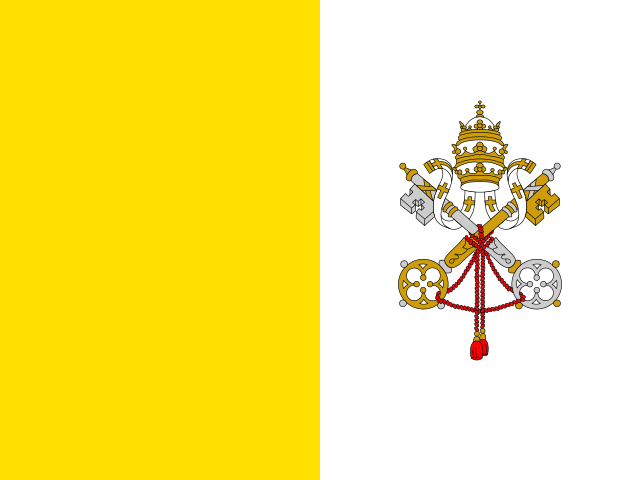
What the flag looks like
The Vatican City flag consists of two equal vertical bands of yellow (hoist) and white (fly), with the papal coat of arms — two crossed keys beneath a papal tiara — in the center of the white band. The proportion is 1:1, making it square — one of only two square national flags in the world. It was adopted on 7 June 1929, when the Lateran Treaty established Vatican City as an independent sovereign state.
Colors and meaning
Yellow and white are the traditional colors of the Papal States and the Holy See, with yellow representing the Pope's spiritual authority and white representing purity and peace. The crossed keys represent the keys of Saint Peter, given to him by Christ, and the papal tiara represents the Pope's authority as head of the Catholic Church.
Yellow band
The traditional papal color of gold, representing the Pope's spiritual authority, wisdom and the divine light. Yellow and gold have been associated with the Papacy since the Middle Ages and appeared on the banners of the Papal States.
White band
Represents purity, peace and the Pope's role as the spiritual leader of the Catholic Church. White is also the traditional color of the Pope's robes.
Papal coat of arms
Features two crossed keys beneath a papal tiara. The keys — one gold and one silver — represent the keys of Saint Peter, which Christ gave him in the Gospel of Matthew with the words 'I will give you the keys of the kingdom of heaven'. The gold key represents spiritual authority and the silver key represents temporal authority. The papal tiara (triregnum) — a three-tiered crown — represents the Pope's threefold authority as teacher, priest and ruler.
Square shape
Like Switzerland's flag, the Vatican City flag is square — the only two square national flags in the world. The Swiss Guard, the Pope's ceremonial bodyguard, uses a square flag based on the Vatican design.
History and adoption
The Papal States, which existed from 754 to 1870, used a variety of flags over the centuries, including yellow and red designs and white and gold designs. When Italian forces captured Rome in 1870, the Papal States were dissolved and the Pope became a 'prisoner in the Vatican'. In 1929, the Lateran Treaty between the Holy See and Italy established Vatican City as an independent sovereign state, and the current flag was adopted on 7 June 1929. The design combined the traditional papal colors of yellow and white with the papal coat of arms, and the square shape was chosen to distinguish it from other national flags. The flag has remained unchanged since, making it one of the most recognizable religious and national flags in the world.
Key facts
- Adopted
- 7 June 1929
- Proportion
- 1:1
- Designer
- Based on the historic papal colors and coat of arms
- Capital
- Vatican City
- Country code
- VA
- Similar flags
- Switzerland
Historical and related flags
The Vatican has used several flags across its long history, and the Papacy continues to use variations for different purposes.
- Papal States (754–1808): Various designs including red and yellow banners.
- Papal States (1808–1870): Yellow and white bicolor used by the Papal States.
- Prisoner in the Vatican (1870–1929): Papal flags used by the Holy See.
- Current flag (1929–present): Yellow and white bands with the papal coat of arms.
- Swiss Guard flag: Based on the Vatican design with additional elements.
- Papal standard: Uses additional elements for different ceremonial purposes.
Frequently asked questions
What does the flag of Vatican City look like?
The flag of Vatican City has two equal vertical bands of yellow (hoist) and white (fly), with the papal coat of arms — two crossed keys beneath a papal tiara — in the center of the white band. The proportion is 1:1, making it one of only two square national flags in the world, along with Switzerland.
When was the flag of Vatican City adopted?
The current flag of Vatican City was officially adopted on 7 June 1929.
What do the colors mean?
Yellow and white are the traditional colors of the Papal States and the Holy See, with yellow representing the Pope's spiritual authority and white representing purity and peace. The crossed keys represent the keys of Saint Peter, given to him by Christ, and the papal tiara represents the Pope's authority as head of the Catholic Church.
Which flags look similar to the Vatican City flag?
Switzerland and Vatican City are the only two countries in the world with square national flags. Switzerland uses a white cross on a red field, while Vatican City uses yellow and white vertical bands with the papal coat of arms.

 Switzerland
 Italy
 San Marino
 Monaco
 Austria
 Spain