What the flag looks like
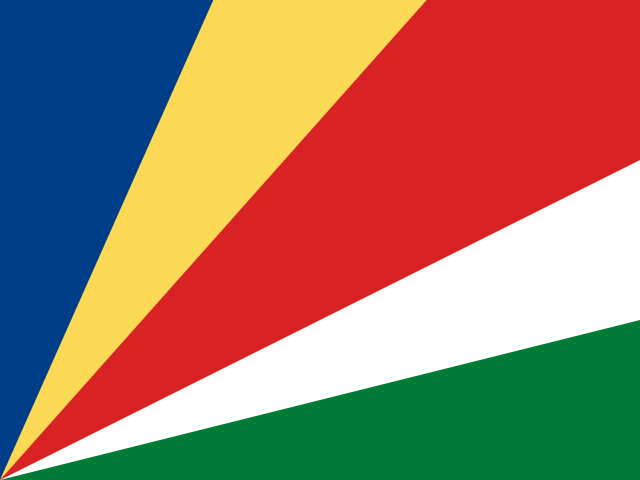
The Seychellois flag consists of five oblique bands radiating from the lower hoist corner — blue, yellow, red, white and green — fanning out toward the upper fly corner. The proportion is 1:2. It was adopted on 18 June 1996, following the adoption of a new constitution, and replaced the earlier red, white and green flag used from 1977.
Colors and meaning
Blue represents the sky and the Indian Ocean that surrounds the Seychelles archipelago, yellow represents the sun and the light that gives the islands life, red represents the people of Seychelles and their determination for the future, white represents social justice and harmony, and green represents the land and the natural environment.
Blue
Represents the sky over Seychelles and the Indian Ocean that surrounds the 115-island archipelago. The ocean is central to the Seychellois economy, culture and way of life.
Yellow
Represents the sun and the light that gives the islands their life, color and warmth. Seychelles enjoys a tropical climate with abundant sunshine year-round.
Red
Represents the people of Seychelles — their unity, determination and hope for the future.
White
Represents social justice and harmony. The white band symbolizes the Seychellois people's commitment to a fair and peaceful society.
Green
Represents the land and the natural environment of Seychelles — the country is known for its pristine beaches, coral reefs and unique flora and fauna.
Radiating design
The five bands radiate outward from the hoist, symbolizing the Seychellois people moving forward together into the future as a united nation.
History and adoption
Seychelles was a French colony from 1756 and a British colony from 1814. The country gained independence from Britain on 29 June 1976, initially as a republic within the Commonwealth. The first flag was a red, white and green design with blue and yellow bands. In 1977, a coup brought France-Albert René to power, and the flag was changed to a red, white and green design. On 18 June 1996, following the adoption of a new constitution and a return to multi-party democracy, the current flag was adopted — a design that deliberately incorporates the colors of the two main political parties to symbolize national unity. It has remained unchanged since.
Key facts
- Adopted
- 18 June 1996
- Proportion
- 1:2
- Designer
- Based on a design by the Seychelles government
- Capital
- Victoria
- Country code
- SC
- Similar flags
- None
Historical and related flags
Seychelles has used three different national flags since independence.
- British Seychelles (1903–1976): British Blue Ensign with various colonial badges.
- First national flag (1976–1977): Red, white, green bands with blue and yellow.
- Socialist flag (1977–1996): Red, white and green bands with wavy lines.
- Current flag (1996–present): Five oblique radiating bands.
- Presidential standard: Uses the Seychellois coat of arms with a giant tortoise and a coco de mer palm.
Frequently asked questions
What does the flag of Seychelles look like?
The flag of Seychelles has five oblique bands radiating from the lower hoist corner to the top and right edge: blue, yellow, red, white and green. The proportion is 1:2.
When was the flag of Seychelles adopted?
The current flag of Seychelles was officially adopted on 18 June 1996.
What do the colors mean?
Blue represents the sky and the Indian Ocean that surrounds the Seychelles archipelago, yellow represents the sun and the light that gives the islands life, red represents the people of Seychelles and their determination for the future, white represents social justice and harmony, and green represents the land and the natural environment.
Which flags look similar to the Seychelles flag?
No other national flag closely resembles Seychelles's. The five radiating oblique bands are unique among national flags — the design is sometimes compared to the flag of the United States state of Hawaii, but the resemblance is superficial.

 Mauritius
 Madagascar
 Comoros
 Maldives
 Sri Lanka
 Gambia