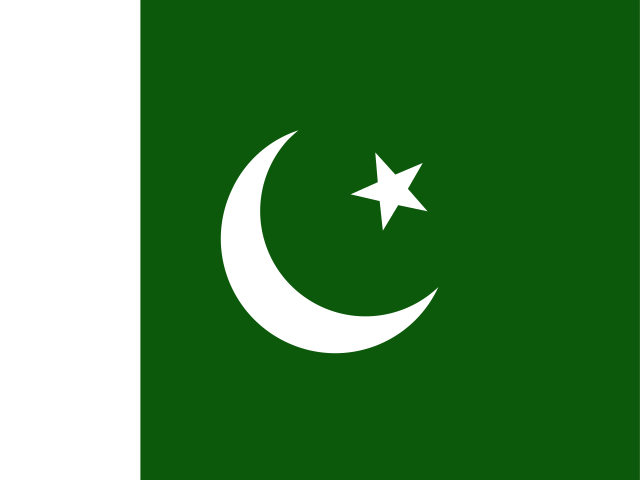
What the flag looks like
The Pakistani flag consists of a green field with a white crescent moon and a white five-pointed star in the center, and a white vertical stripe on the hoist side (one-quarter of the flag's width). The proportion is 2:3. It was adopted on 11 August 1947, three days before Pakistan gained independence from Britain.
Colors and meaning
Green represents Islam and the Muslim majority of Pakistan, white represents the religious minorities of Pakistan, and the crescent and star are traditional symbols of Islam. The white hoist stripe represents the non-Muslim population and the principle of religious freedom and minority rights.
Green
Represents Islam and the Muslim majority of Pakistan. The deep green field is one of the most distinctive national flags, and its shade is formally specified as a dark green.
White
Represents the religious minorities of Pakistan — Christians, Hindus, Sikhs, Buddhists and others — and the principle of religious freedom and minority rights. The white stripe on the hoist is one-quarter of the flag's width, emphasizing the importance of religious tolerance in the Pakistani state.
Crescent
Represents Islam and progress. The crescent faces the fly side of the flag and is one of the oldest symbols of Islamic identity.
Five-pointed star
Represents the five pillars of Islam and light and knowledge. The star is positioned inside the opening of the crescent.
Design origin
The flag is based on the flag used by the All-India Muslim League, which led the movement for a separate Muslim state in South Asia. The design was created by Ameer-ud-Din Kidwai and approved by Muhammad Ali Jinnah, the founder of Pakistan. It was adopted on 11 August 1947.
History and adoption
Pakistan was created on 14 August 1947, when British India was partitioned into two independent states — India and Pakistan. The Pakistani flag was adopted on 11 August 1947, three days before independence, by the Constituent Assembly of Pakistan. The design was based on the flag of the All-India Muslim League, which had led the independence movement. The original flag used by the Muslim League was plain green with a crescent and star; the white hoist stripe was added to represent religious minorities. The flag has remained unchanged since, despite the separation of Bangladesh (then East Pakistan) in 1971.
Key facts
- Adopted
- 11 August 1947
- Proportion
- 2:3
- Designer
- Ameer-ud-Din Kidwai, based on the All-India Muslim League flag
- Capital
- Islamabad
- Country code
- PK
- Similar flags
- Turkey, Algeria, Tunisia
Historical and related flags
Pakistan has used the same national flag since its independence, with several official variants for government use.
- All-India Muslim League (1906–1947): Plain green with a white crescent and star.
- Current flag (1947–present): Green field with crescent and star, and white hoist stripe.
- Presidential standard: Uses the Pakistani coat of arms with a crescent, star and wreath.
- Naval ensign: White ensign with a green cross of St George and the Pakistani flag in the canton.
- Air force ensign: Light blue with the Pakistani flag in the canton and a roundel on the fly.
Frequently asked questions
What does the flag of Pakistan look like?
The flag of Pakistan is a green field with a white crescent moon and a white five-pointed star, and a white vertical stripe on the hoist side. The proportion is 2:3.
When was the flag of Pakistan adopted?
The current flag of Pakistan was officially adopted on 11 August 1947.
What do the colors mean?
Green represents Islam and the Muslim majority of Pakistan, white represents the religious minorities of Pakistan, and the crescent and star are traditional symbols of Islam. The white hoist stripe represents the non-Muslim population and the principle of religious freedom and minority rights.
Which flags look similar to the Pakistan flag?
Turkey uses a red field with a white crescent and star. Algeria and Tunisia use red fields with crescent and star in different arrangements. Pakistan's green field with a white crescent and star and white hoist stripe is unique.

 India
 Afghanistan
 Iran
 China
 Turkey
 Bangladesh