What the flag looks like
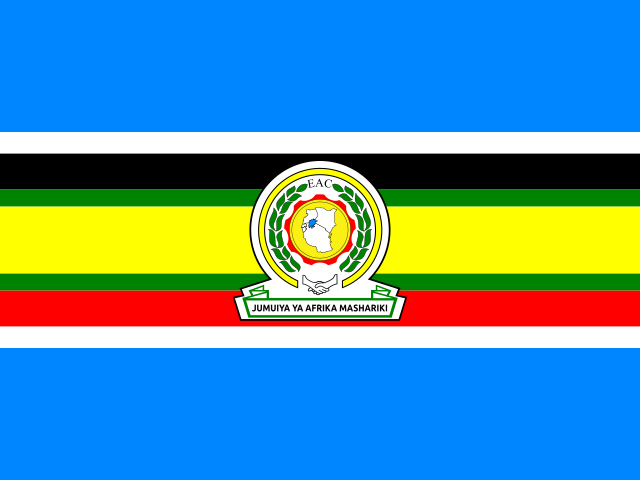
The East African Community flag consists of a blue field with a white circle in the center. Inside the circle is the EAC emblem — a map of the member states shown in brown, surrounded by a ring of colors and topped by a handshake symbol representing cooperation and unity among the member states. The proportion is 2:3. The current design was adopted in 2008, replacing an earlier version adopted in 2003.
Colors and meaning
The blue field represents Lake Victoria and the Indian Ocean, which are central to the region's geography and economy, and the sky above East Africa. The white circle represents peace and unity. The emblem's colors — green, yellow, red, blue, black and white — represent the diverse peoples and landscapes of the member states, and the handshake symbolizes cooperation and integration.
Blue field
Represents the waters that connect the East African region — Lake Victoria, Lake Tanganyika, Lake Malawi and the Indian Ocean — and the sky above East Africa. Blue is also a color of peace and stability.
White circle
Represents peace, unity and the shared aspirations of the East African peoples. The circle also frames the EAC emblem, emphasizing its central importance.
EAC emblem
The emblem contains a map of the member states in brown, surrounded by a ring in the colors of the member states' flags, and topped by a handshake symbol. The handshake represents cooperation, friendship and unity among the member states, and the map represents the geographic scope of the community. The emblem's colors — green, yellow, red, blue, black and white — reflect the diversity of the member states' cultures and landscapes.
Regional integration
The EAC is one of the most integrated regional communities in Africa, with a customs union, a common market and (as of 2010) a common external tariff. The flag represents this integration and the shared East African identity that the community seeks to build.
History and adoption
The East African Community was originally founded in 1967 by Kenya, Uganda and Tanzania, but it collapsed in 1977 due to political differences. It was revived on 7 July 2000 with the signing of the Treaty for the Establishment of the East African Community, again by Kenya, Uganda and Tanzania. Rwanda and Burundi joined in 2007, South Sudan joined in 2016, and the Democratic Republic of the Congo joined in 2022. The first EAC flag was adopted in 2003, and the current version was adopted in 2008 with minor adjustments to the emblem. The flag has remained unchanged since, and it represents one of the most ambitious regional integration projects in Africa.
Key facts
- Adopted
- 2008 (originally 2003)
- Proportion
- 2:3
- Designer
- East African Community Secretariat
- Capital
- Arusha (headquarters)
- Country code
- EAC
- Similar flags
- African Union, United Nations
Historical and related flags
The East African Community has used several flags since its revival in 2000.
- Original EAC (1967–1977): A flag with the EAC emblem used by the first community before its collapse.
- Revived EAC (2000–2003): Used the founding treaty's temporary emblem.
- First official flag (2003–2008): Blue field with the EAC emblem.
- Current flag (2008–present): Refined version with an updated emblem.
- East African Legislative Assembly: Uses the EAC flag with additional elements.
Frequently asked questions
What does the flag of East African Community look like?
The flag of the East African Community is a blue field with a white circle in the center bearing the EAC emblem — a map of the member states surrounded by a ring of colors and topped by a handshake symbol. The proportion is 2:3.
When was the flag of East African Community adopted?
The current flag of East African Community was officially adopted on 2008 (originally 2003).
What do the colors mean?
The blue field represents Lake Victoria and the Indian Ocean, which are central to the region's geography and economy, and the sky above East Africa. The white circle represents peace and unity. The emblem's colors — green, yellow, red, blue, black and white — represent the diverse peoples and landscapes of the member states, and the handshake symbolizes cooperation and integration.
Which flags look similar to the East African Community flag?
The African Union and United Nations flags also use blue fields with central emblems. The EAC flag's specific emblem — a map of East Africa with a handshake — is unique and distinguishes it from other African and international organization flags.

 Kenya
 Uganda
 Tanzania
 Rwanda
 Burundi
 South Sudan
 DR Congo