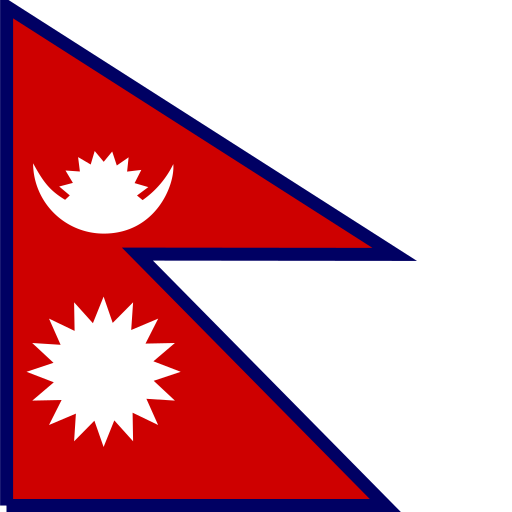
What the flag looks like
The Nepali flag is a double pennant shape, combining two triangular forms into a single flag. The upper pennant bears a white crescent moon and an eight-rayed sun, and the lower pennant bears a white twelve-rayed sun. Both pennants are crimson red with a deep blue border. The flag was formally adopted on 16 December 1962, when Nepal standardized its national symbols. Its unique shape makes it the only non-quadrilateral national flag in the world.
Colors and meaning
Crimson represents the color of the rhododendron — the national flower of Nepal — and is also the traditional color of Nepal's Hindu heritage, representing bravery and the courage of the Nepali people. Blue represents peace, harmony and the Himalayan skies, and white represents purity and the snow of the Himalayas.
Crimson
Represents the rhododendron, the national flower of Nepal, and the traditional color of Nepal's Hindu heritage. Crimson also represents the bravery and courage of the Nepali people.
Blue border
Represents peace, harmony and the clear blue skies over the Himalayas. The border surrounds both pennants and unites them into a single flag.
Crescent moon
Represents the calm and peaceful nature of the Nepali people, and the shade and coolness of the Himalayan region. In some interpretations, it also represents Nepal's royal past.
Sun
Represents the fierce resolve and warmth of the Nepali people, and the heat and brightness of the Terai lowlands. The sun's rays are drawn with twelve points on the lower pennant.
Two pennants
The two pennants represent the two main religions of Nepal — Hinduism and Buddhism — and the two ruling dynasties of Nepal's history. Together they also represent the Himalayan mountains that define Nepal's geography.
History and adoption
Nepal has used a double-pennant flag for centuries, with the design evolving over time. The flag's origins trace back to the unification of Nepal in the 18th century under Prithvi Narayan Shah, whose dynasty used a similar double-pennant design. The flag has been in continuous use since at least the 19th century. It was formally standardized by the Nepali government on 16 December 1962, following the introduction of the country's new constitution. The moon and sun faces were removed in the 1962 version to give the flag a simpler, more modern appearance. The flag's unique non-rectangular shape has been retained despite many proposals to change it to a standard rectangle, as the Nepali people consider the shape an important part of their national identity.
Key facts
- Adopted
- 16 December 1962
- Proportion
- Unique non-rectangular shape defined by geometric construction
- Designer
- Traditional design, standardized by Shankar Nath Rimal in 1962
- Capital
- Kathmandu
- Country code
- NP
- Similar flags
- None
Historical and related flags
Nepal has used several variations of the double-pennant flag across its history.
- Kingdom of Nepal (18th–19th century): Various double-pennant flags used by the Shah dynasty.
- Kingdom of Nepal (1856–1962): Double pennant with moon and sun faces.
- Current flag (1962–present): Standardized double-pennant design without facial features on the moon and sun.
- Presidential standard: Uses the Nepali coat of arms with Mount Everest, the national flower and other symbols.
Frequently asked questions
What does the flag of Nepal look like?
The flag of Nepal is the only national flag in the world that is not rectangular or square. It consists of two stacked crimson pennants — a smaller upper triangle with a white crescent moon and an eight-rayed sun, and a larger lower triangle with a white twelve-rayed sun. The border of the flag is deep blue.
When was the flag of Nepal adopted?
The current flag of Nepal was officially adopted on 16 December 1962.
What do the colors mean?
Crimson represents the color of the rhododendron — the national flower of Nepal — and is also the traditional color of Nepal's Hindu heritage, representing bravery and the courage of the Nepali people. Blue represents peace, harmony and the Himalayan skies, and white represents purity and the snow of the Himalayas.
Which flags look similar to the Nepal flag?
No other national flag is non-rectangular, and no other national flag closely resembles Nepal's. The double-pennant shape with a moon and sun is completely unique.

 India
 Bangladesh
 Sri Lanka
 Pakistan
 Myanmar
 Bhutan