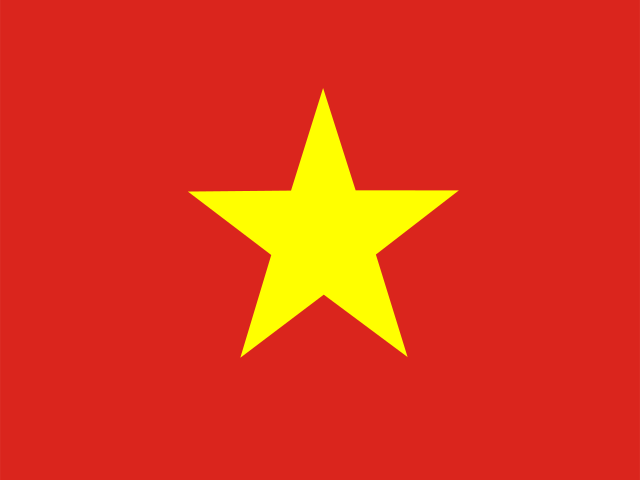
What the flag looks like
The Vietnamese flag consists of a plain red field with a large golden five-pointed star in the center. The red field represents the revolutionary struggle and the sacrifices made for national independence. The golden star represents the leadership of the Communist Party and the unity of the Vietnamese people. The five points of the star are traditionally associated with workers, peasants, soldiers, intellectuals and businesspeople. The proportion is 2:3.
Colors and meaning
Red represents revolution, independence and the struggle of the Vietnamese people, while the golden star represents the revolutionary movement and the unity of the Vietnamese people. The five points of the star traditionally represent workers, peasants, soldiers, intellectuals and businesspeople.
Red field
Represents revolution, national independence and the struggle of the Vietnamese people. It also symbolizes the sacrifices made during the country's revolutionary and independence movements.
Golden star
Represents the revolutionary leadership and the unity of the Vietnamese people. Its golden color is associated with the traditional importance of gold and with the country's revolutionary symbolism.
Five points
The five points of the star are traditionally interpreted as representing five major groups of Vietnamese society: workers, peasants, soldiers, intellectuals and businesspeople.
History and adoption
The modern Vietnamese flag originated with the Viet Minh, the communist-led independence movement founded in 1941. The red flag with a yellow star was first associated with the August Revolution of 1945, when the Viet Minh overthrew Japanese-backed colonial authorities and proclaimed Vietnamese independence. The Democratic Republic of Vietnam adopted the design as its national flag on 5 September 1945. After the reunification of North and South Vietnam in 1976, the same basic flag became the national flag of the Socialist Republic of Vietnam. The design has remained unchanged since reunification.
Key facts
- Adopted
- 5 September 1945
- Proportion
- 2:3
- Designer
- Nguyễn Hữu Tiến
- Capital
- Hanoi
- Country code
- VN
- Similar flags
- China
Historical and related flags
Vietnam has used several important flags during its imperial, colonial, revolutionary and modern periods.
- Nguyễn dynasty (1802–1945): Various imperial yellow flags were used during the Nguyễn dynasty.
- French Indochina period (1887–1945): French colonial flags and Vietnamese imperial flags were used in different official contexts.
- Viet Minh flag (1941–1945): Red field with a golden star, becoming the principal symbol of the independence movement.
- Democratic Republic of Vietnam (1945–1976): Red flag with a golden star used by North Vietnam.
- Republic of Vietnam (1955–1975): Yellow flag with three horizontal red stripes, used by South Vietnam.
- Socialist Republic of Vietnam (1976–present): The red flag with a golden star became the national flag following reunification.
Frequently asked questions
What does the flag of Vietnam look like?
The flag of Vietnam has a red field with a large golden five-pointed star centered in the middle. Red represents revolution and the struggle for independence, while the golden star represents the revolutionary leadership and the unity of the Vietnamese people. The proportion is 2:3.
When was the flag of Vietnam adopted?
The current flag of Vietnam was officially adopted on 5 September 1945.
What do the colors mean?
Red represents revolution, independence and the struggle of the Vietnamese people, while the golden star represents the revolutionary movement and the unity of the Vietnamese people. The five points of the star traditionally represent workers, peasants, soldiers, intellectuals and businesspeople.
Which flags look similar to the Vietnam flag?
Vietnam's flag resembles China's because both use a red field with a golden star motif. Vietnam has one large centered star, while China has one large star surrounded by four smaller stars in the upper hoist corner.

 China
 Laos
 North Korea
 Cambodia
 Malaysia
 Singapore