What the flag looks like
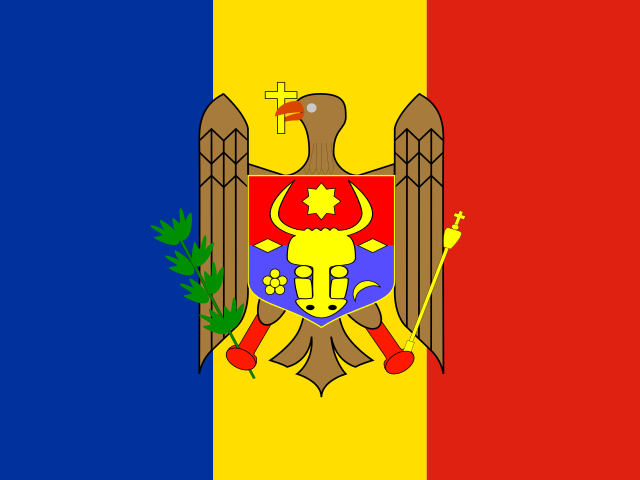
The Moldovan flag consists of three equal vertical bands of blue (hoist), yellow (center) and red (fly), with the Moldovan coat of arms centered on the yellow band. The coat of arms features a brown eagle holding a golden cross in its beak, with a shield on its chest bearing an aurochs head, a star, a rose and a crescent. The proportion is 1:2. It was adopted on 6 November 1990.
Colors and meaning
Blue represents liberty, the sky and Moldova's rivers, yellow represents justice, prosperity and the country's fertile fields, and red represents brotherhood, courage and the blood shed for Moldovan independence. The colors mirror those of neighboring Romania, reflecting shared cultural and historical heritage.
Blue
Represents liberty, the sky and Moldova's rivers, including the Prut and Dniester. Blue is also one of the historic colors of the Principality of Moldavia.
Yellow
Represents justice, prosperity and Moldova's fertile farmland and vineyards. It is the color of the middle band and the background for the coat of arms.
Red
Represents brotherhood, courage and the blood shed for Moldovan independence. It is also the field color of the historic flag of the Principality of Moldavia.
Aurochs head
The central symbol of the coat of arms is the head of an aurochs (an extinct wild ox), which was the emblem of the Principality of Moldavia from the 14th century.
Eagle
The brown eagle holding a cross in its beak is a symbol shared with Romania, representing the Latin and Christian heritage of the region.
History and adoption
Moldova declared independence from the Soviet Union on 27 August 1991, but the flag was adopted earlier, on 6 November 1990, during the final months of the Moldavian SSR. The design was based on the Romanian tricolor, reflecting the shared cultural and linguistic heritage of Moldova and Romania. During the Soviet period, the Moldavian SSR used a red flag with a green stripe and a hammer-and-sickle emblem. The current flag has remained unchanged since independence, though its use is a subject of political debate between those who favor closer ties with Romania and those who support a distinct Moldovan identity.
Key facts
- Adopted
- 6 November 1990
- Proportion
- 1:2
- Designer
- Traditional — derived from the Romanian tricolor
- Capital
- Chișinău
- Country code
- MD
- Similar flags
- Romania, Chad, Andorra
Historical and related flags
Moldova has used several flags across its medieval, Romanian, Soviet and post-Soviet periods.
- Principality of Moldavia (14th–19th century): Red flag with an aurochs head.
- Kingdom of Romania (1918–1940): Romanian tricolor used when Bessarabia was part of Romania.
- Moldavian ASSR (1924–1940): Soviet red flag with hammer and sickle.
- Moldavian SSR (1940–1952): Red flag with hammer and sickle and Cyrillic initials.
- Moldavian SSR (1952–1990): Red flag with a green stripe.
- Current flag (1990–present): Romanian-style tricolor with the Moldovan coat of arms.
Frequently asked questions
What does the flag of Moldova look like?
The flag of Moldova has three equal vertical bands of blue (hoist), yellow (center) and red (fly), with the Moldovan coat of arms in the center of the yellow band. The proportion is 1:2.
When was the flag of Moldova adopted?
The current flag of Moldova was officially adopted on 6 November 1990.
What do the colors mean?
Blue represents liberty, the sky and Moldova's rivers, yellow represents justice, prosperity and the country's fertile fields, and red represents brotherhood, courage and the blood shed for Moldovan independence. The colors mirror those of neighboring Romania, reflecting shared cultural and historical heritage.
Which flags look similar to the Moldova flag?
Romania and Chad use the same blue-yellow-red vertical tricolor. Romania's is nearly identical but without the coat of arms. Chad uses a slightly darker blue. Moldova's aurochs-head coat of arms is unique.

 Romania
 Ukraine
 Chad
 Andorra
 Bulgaria
 Russia