What the flag looks like
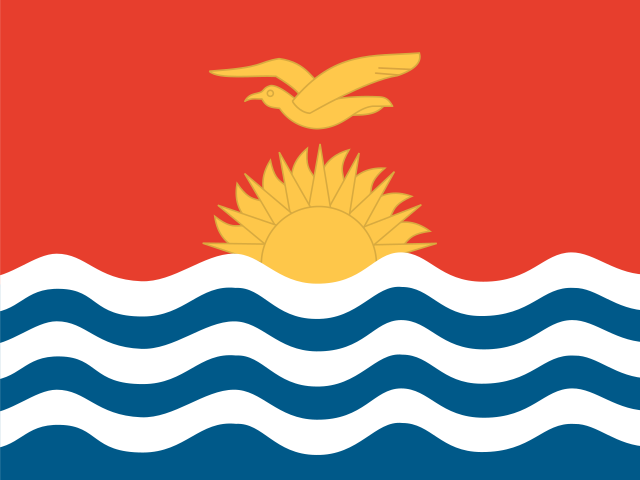
The Kiribati flag consists of a red field in the upper half, with a golden frigatebird flying over a rising golden sun. Below is a series of blue and white wavy horizontal stripes representing the Pacific Ocean, with the white stripes representing the equator. The proportion is 1:2. It was adopted on 12 July 1979, when Kiribati gained independence from Britain.
Colors and meaning
Red represents the sky over Kiribati, gold represents the sun and the frigatebird — the national bird of Kiribati — and the blue and white wavy stripes represent the Pacific Ocean and the equator, which passes through the Kiribati archipelago. The rising sun represents the country's bright future and its position straddling the equator and the International Date Line.
Red field
Represents the sky over the Kiribati islands and the tropical sunsets of the Pacific. Red is also a traditional color of Pacific island cultures and appears on many flags of the region.
Golden frigatebird
The frigatebird is the national bird of Kiribati. It represents the country's freedom, its maritime heritage and the traditional skills of I-Kiribati sailors, who used frigatebirds to help them navigate across the Pacific. The frigatebird is a symbol of Kiribati's connection to the sea and its proud seafaring tradition.
Rising sun
Represents the country's bright future and its position straddling the equator and the International Date Line — Kiribati is one of the first places in the world to see the sunrise each day. The rising sun also represents a new dawn for the newly independent nation in 1979.
Blue and white wavy stripes
Represent the Pacific Ocean that surrounds the Kiribati archipelago. The white wavy stripes represent the equator, which passes through the Kiribati islands, and the blue represents the ocean waves. There are three blue stripes and three white stripes, representing the three main island groups of Kiribati — the Gilbert Islands, the Phoenix Islands and the Line Islands.
History and adoption
Kiribati, formerly known as the Gilbert Islands, was a British protectorate from 1892 and part of the Gilbert and Ellice Islands Colony from 1916. In 1975, the Ellice Islands separated to become Tuvalu, and the Gilbert Islands became the separate colony of Kiribati in 1976. Kiribati gained independence on 12 July 1979, and the current flag was adopted on the same day. The design was chosen in a competition and combines the frigatebird, the rising sun and the wavy ocean stripes to represent Kiribati's position on the equator and its maritime heritage. The flag has remained unchanged since.
Key facts
- Adopted
- 12 July 1979
- Proportion
- 1:2
- Designer
- Based on a design by Sir Arthur Grimble, adapted by the Kiribati government
- Capital
- Tarawa
- Country code
- KI
- Similar flags
- None
Historical and related flags
Kiribati used several flags during its British colonial period before independence.
- British protectorate (1892–1916): British Union Jack used as the official flag.
- Gilbert and Ellice Islands (1916–1976): British Blue Ensign with a colonial badge featuring a frigatebird and waves.
- Gilbert Islands colony (1976–1979): Blue Ensign with a badge bearing a frigatebird and the rising sun.
- Current flag (1979–present): Red field with frigatebird, sun and wavy ocean stripes.
- Presidential standard: Uses the Kiribati coat of arms with a frigatebird, sun and waves.
Frequently asked questions
What does the flag of Kiribati look like?
The flag of Kiribati is a red field with a golden frigatebird flying above a rising golden sun and blue and white wavy stripes representing the Pacific Ocean and the equator. The proportion is 1:2.
When was the flag of Kiribati adopted?
The current flag of Kiribati was officially adopted on 12 July 1979.
What do the colors mean?
Red represents the sky over Kiribati, gold represents the sun and the frigatebird — the national bird of Kiribati — and the blue and white wavy stripes represent the Pacific Ocean and the equator, which passes through the Kiribati archipelago. The rising sun represents the country's bright future and its position straddling the equator and the International Date Line.
Which flags look similar to the Kiribati flag?
No other national flag closely resembles Kiribati's. The combination of a golden frigatebird over a rising sun with wavy blue and white ocean stripes is unique.

 Tuvalu
 Nauru
 Marshall Islands
 Fiji
 Solomon Islands
 Samoa