What the flag looks like
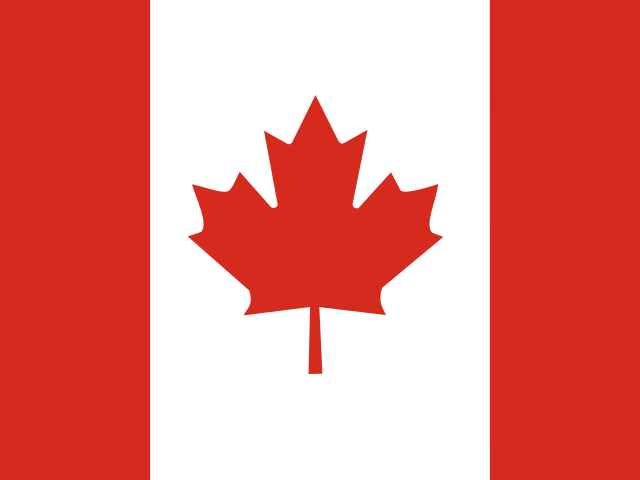
The Canadian flag consists of two red vertical bands on the hoist and fly sides, with a white square in the center of equal width to each red band. Inside the white square sits a stylized 11-pointed red maple leaf. The flag proportion is 1:2, twice as wide as it is tall, making it one of the widest national flags in the world.
Colors and meaning
Red represents the blood shed by Canadians in war and the country's British heritage, and white represents peace and the French heritage of Canada. The maple leaf is the national symbol of Canada and has been used since the early 19th century.
Red
Represents the blood shed by Canadians in the First and Second World Wars and the country's shared British and French heritage. Red is also the color of the St George's Cross, symbol of England.
White
Represents peace and honesty, and is the traditional color of the French monarchy, referencing Canada's French heritage.
Maple leaf
The 11-pointed maple leaf is a stylized design by Jacques Saint-Cyr. It symbolizes the natural landscape and identity of Canada, and has been used as a national symbol since the 1830s.
History and adoption
The Canadian flag was adopted on 15 February 1965, following the Great Flag Debate of 1964. Before that, Canada used the Canadian Red Ensign, which featured the Union Jack in the canton and the Canadian coat of arms on a red field. In 1964, Prime Minister Lester B. Pearson proposed a new national flag, and after months of debate, a parliamentary committee selected the design by George Stanley, based on the flag of the Royal Military College of Canada. It was approved by Parliament and proclaimed by Queen Elizabeth II on 28 January 1965.
Key facts
- Adopted
- 15 February 1965
- Proportion
- 1:2
- Designer
- George Stanley (design), Jacques Saint-Cyr (maple leaf)
- Capital
- Ottawa
- Country code
- CA
- Similar flags
- Peru
Historical and related flags
Canada used several flags before the current Maple Leaf design was adopted in 1965.
- Canadian Red Ensign (1892–1965): Union Jack in the canton with the Canadian coat of arms on a red field.
- Canadian Blue Ensign: Similar design on a blue field, used on government vessels.
- Pearson Pennant (1964): A proposed design with blue bars and three maple leaves, rejected by Parliament.
- Maple Leaf (1965–present): Current design by George Stanley.
Frequently asked questions
What does the flag of Canada look like?
The flag of Canada has a red field on the hoist and fly with a white square in the center, and an 11-pointed red maple leaf in the middle of the white square. The proportion is 1:2.
When was the flag of Canada adopted?
The current flag of Canada was officially adopted on 15 February 1965.
What do the colors mean?
Red represents the blood shed by Canadians in war and the country's British heritage, and white represents peace and the French heritage of Canada. The maple leaf is the national symbol of Canada and has been used since the early 19th century.
Which flags look similar to the Canada flag?
Peru uses a vertical red-white-red design but with the red bands of equal width and no central emblem. Canada's white square is twice as wide as each red band and features the maple leaf.

 United States
 United Kingdom
 Peru
 Australia
 New Zealand
 France